

When it comes to going head to head with China on crucial products, like electric vehicle batteries and automobile components, the U.S. may be its own worst enemy.
U.S. industrial policy, traditionally a low priority because of its market-driven economy, is little match for the bottomless pit of centralized government funding and mandates that China is willing to provide its businesses. If Beijing wants to position China in an area like electric vehicle batteries, it has virtually limitless capital to do so. It also has the mandate of its centralized government, which is unfettered by an electorate, ownership of IP rights and rule of law.
Historically, the U.S. has been content to let the business take care of itself and competition to crown winners. That approach has often worked. However, it is no longer a reliable strategy in the face of Chinese competition. U.S. investors expect more immediate returns, where China is willing to provide both funding and favorable laws to assure that the manufacture and control of vital products succeed, no matter who might own their IP rights.
Consequences of Outsourcing
“Even though the national security threats posed by China seem like one of the few areas of bipartisan agreement in Washington these days,” reports Bloomberg Businessweek,”the idea of government taking a more muscular role in commercializing technology does not sit well with many Americans.
“For all of the fury over China’s brazen plunder of American intellectual property, the consequences of our unchecked outsourcing don’t attract nearly as much political scrutiny.”
In 2012, for example, China’s Wanxiang Group, China’s largest manufacturer of auto parts and a key supplier to Ford and General Motors, beat Johnson Controls, NEC, and Siemens for the acquisition of the bankrupt American battery maker A123 Systems’ non-government businesses.
A123 had received U.S. Department of Energy grants totalling $250.
“For all of the fury over China’s brazen plunder of American intellectual property, the consequences of our unchecked outsourcing don’t attract nearly as much political scrutiny.”
“All these years later,” says Bloomberg, “it is still unclear who has access to the spoils of the A123 IP or how widely they were shared. There are still traces of A123’s technology inside of China’s vast battery supply chain.”
In other industries, like smart phones and automobile manufacturing, it is believed that many patents and much know-how was shared willingly with Chinese businesses by companies like Apple, Motorola and General Motors in the hope of gaining early entry to the nation’s 700 million-member middle class. The market, larger than the U.S. and Europe combined, is simply too attractive to ignore — consequences notwithstanding.
Tenfold Head Start
China’s lithium ion battery manufacturing capacity currently is more than ten times that of the U.S, and the U.S. is even behind Europe. According to Bloomberg’s 2023 EV Outlook, U.S. production will improve only modestly by 2030.
“The U.S. has long thought of itself as an innovation machine powered by the virtues of shareholder capitalism. We stick with this belief,” wrote Intel’s Andy Grove in 2010, “largely oblivious to emerging evidence that while free markets beat planned economies, there may be room for modification that is even better.”
The IP theft on the part of China involves smaller U.S. companies, too.
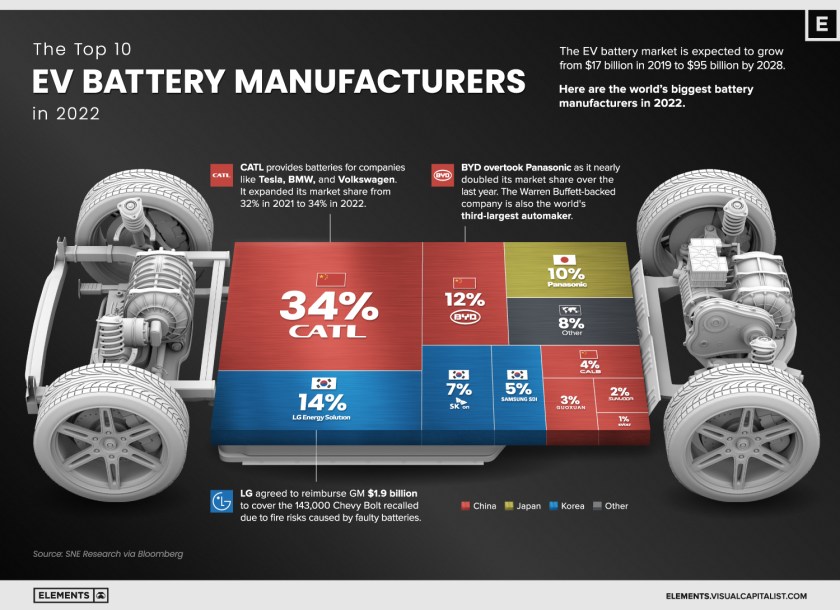
The U.S. needs to alter its industrial policy in light of what the Chinese are able to accomplish, quickly, with theirs. The abundance of capital and absence of democracy in Beijing gives it a deceptive advantage with which the U.S. must learn to compete.
The following will help:
- a renewed commitment to R&D on the part of government and business;
- respect for intellectual property rights for both businesses and creators;
- informed audiences that are aware of what is happening and why; and
- reaffirmation of the competitive values that made the U.S. the the great innovation nation it is and can still remain.
Image source: VisualCapitalist; Taylor Callery for foreignaffairs.com
 ipcloseup.com