
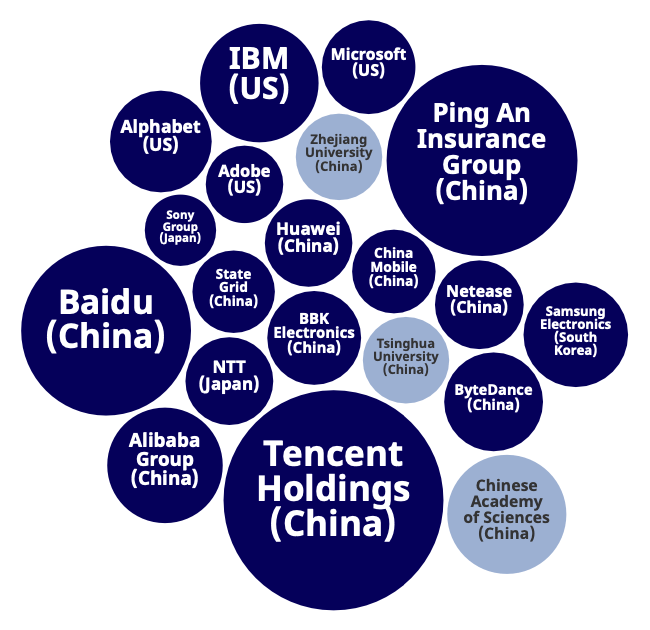
The outsized media coverage of last week’s World Intellectual Property Organization report on generative artificial intelligence shows China holds a huge lead on the U.S. in patent grants.
The lead is not much of a surprise for those who have been following IP developments and AI. Surely, patent counts mean something – but usually a lot less than many think. Mysterious is the report’s emphasis on quantity over quality and lack of context about where the patents were issued and how the owner plans to use them.
The WIPO report shows that six of the top ten GenAI grantees are based in China – Tencent, Ping An Insurance, Baidu, Chinese Academy of Sciences, Alibaba Group and Bytedance. Only three are U.S. businesses: IBM, Alphabet and Microsoft.
Between the 2014 and 2023 finds Generative Artificial Intelligence: A Patent Landscape Report, China was granted six times as many patents as the U.S.
It is useful to track global patent trends but If most of the patent grants were from CNIPA, the Chinese patent office, and I suspect they are, they are of questionable significance. If they include patents granted in the U.S. and Europe, where the patentability standard is generally higher and the rule of law more predictable, they would have somewhat more meaning. Likely some are.
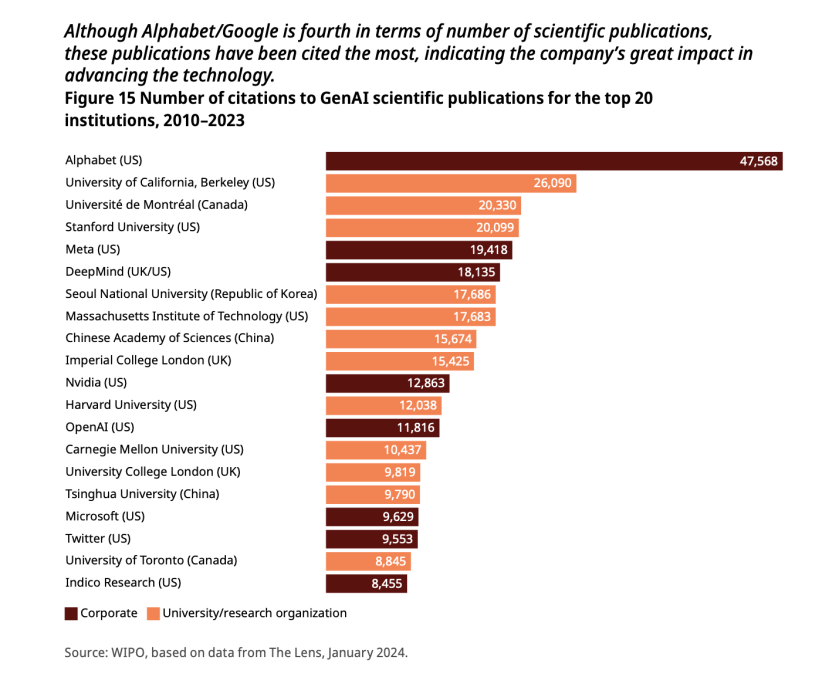
Citations of other patents is a factor recognizing quality. The most heavily cited company in the top 20 is Alphabet. Many other global businesses, universities and research institutions are cited. Despite the huge number of Chinese patents, only the Chinese Academy of Sciences and Tsinghua University made the list of 20 (below).
Freedom to Operate?
Of potential concern is how China will use its AI patents. Unlike large Japanese companies of the 1990s that filed abundantly in the U.S., receiving generally mediocre or “paper” patents they had no intention of enforcing, China may wish to pursue a more aggressive strategy.
It would be concerning if its patents are less about freedom to operate in China or elsewhere than slowing competitors or simply stopping them from selling their products with patent injunctions, which exist in China but since the eBay v. MercExchange in 2005 are effectively unavailable in the U.S.
“Instead of focusing on how to address the rest of the world’s advances, the emphasis should be on a renewed commitment to make sure the U.S. leads in workforce, patenting, investment, education and innovation”
Injunctive relief can stop a business dead in its tracks by preventing it from selling a particular product even before there is a trial.
If many AI patents, like those covering software and algorithm inventions, are questionably valid, and they are, China’s GenAI IP activity may be more more about optics than meaningful innovation. The activity does suggest the nation and its businesses and universities are taking GAI and LLM’s seriously. Whether they have something worth protecting — and whether it can be under most legal systems’ patentability requirements — is another matter. Often, little is certain until a dispute is litigated, and even then. certainty is a moving target.
A Matter of Quality
Utility patents are counted from the patents issued in a particular country, and the standard of quality can differ widely.
“China systematically over-patents and the patents are not necessarily good,” says Robert Atkinson, president of the Information Technology and Innovation Foundation (ITIF). One factor is financial incentives in the country to file for patent protection.
An abundance of patents in a particular technology, such as generative AI, enforceable or not, and a flood of prior-art establishing publications, can serve to derail competitors’ patent strategy.
“What we’re seeing is not so much of an erosion of capability of the United States but of convergence” as other countries advance, says Dario Gil, director of IBM Research and a member of the National Science Board told Axios.
Stated in the WIPO report:
- 54,000 GenAI-related inventions (patent families) were filed and more than 75,000 scientific publications published between 2014 and 2023.
- The growth is rapid, with the number of GenAI patents increasing eightfold since the 2017 introduction of the deep neural network architecture behind the Large Language Models that have become synonymous with GenAI.
- In 2023 alone over 25% of all GenAI patents globally were published, and over 45% of all GenAI scientific papers were published.
- GenAI patents still currently only represent 6% of all AI patents globally.
The U.S. Needs a Renewed Commitment to Innovation
“Instead of focusing on how to address the rest of the world’s advances, the emphasis should be on ‘a renewed commitment to make sure the United States leads’ in workforce, patenting, investment, education and innovation,” Gil says.
Tap here for the full 114-page report, Generative Artificial Intelligence: A Patent Landscape Report.
Image source: WIPO Report
 ipcloseup.com