
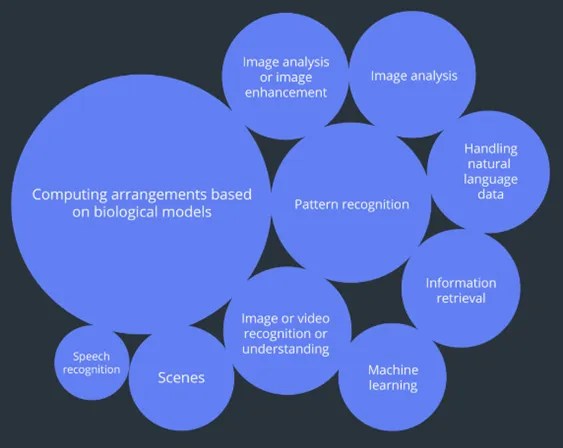
Businesses and investors tend to put more emphasis on some technologies and patent classes than others.
Over the past five years more than half a million artificial intelligence-related patent applications have been filed in the U.S. alone.
Perhaps the obsessive rush to file is rooted the failure to recognize patent value in the Internet and digital search in the 1990s.
When its comes to artificial intelligence patents, both generative and machine learning, it is not just about the perceived frontrunners, OpenAI/Microsoft and Gemini/Google. In fact the most active filer is IBM, with 1,591 AI-related patent applications. Big Blue is followed by followed by Google, Microsoft, Samsung, Intel and Adobe, Capital One and China’s Baidu.
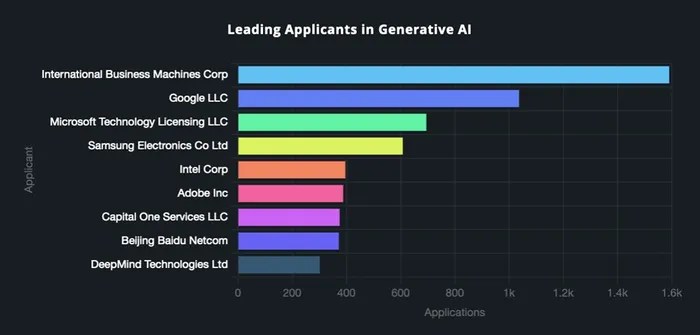
Meta/Facebook, Amazon and Apple are further behind in the AI patent race, but may not feel compelled to compete that way. Meta is arguing for open source AI, an appealing alternative given the company’s overall business model.
Just 22% of all AI patent apps are for generative AI LLMS. This makes machine learning robotics, predictive, risk and health science are a far bigger focus than most people think.
IFI Claims reports that while GenAI patens have grown at a 16% compound annual rate over the past five years, other types of AI have almost doubled that at 31%.
Below are some other types of AI that are not normally associated with generative LLMs:
-
Traditional AI
-
Analyzes data and makes predictions, and excels at pattern recognition.
-
Multimodal AI
-
Processes multiple input types, such as text, images, and sound, to mimic human sensory information processing.
-
Machine learning (ML) AI
-
Creates software that can learn independently by accessing and using data, and can improve itself through experience without direct programming.
-
Deep learning
-
An umbrella term that covers many other types of AI, including machine learning done with neural networks.
-
Reactive machines
-
The most basic type of AI solution, which only reacts to current conditions and doesn’t learn from past experiences or form memories.
-
Limited memory AI
-
Uses short-term memory to learn from past experiences and make better decisions for the future.
-
Discriminative AI
-
Focuses on classifying or identifying content based on preexisting data.
-
Neural networks
Organize data for AI applications in a layered approach, inspired by the human brain, with nodes arranged like brain neurons.
“The substance of AI boils down to this,” writes IFI Claims. “The process of training computers on large data sets so that the machines can make predictions and solve problems in a way that mimics human reasoning.”
Machine learning, artificial neural networks (a.k.a. deep learning) and natural language processing are some of the technologies that underlie AI.
“The world is certainly heading in this direction, and companies have been hard at it in the race to claim patent space in the area.”
The company behind ChatGPT, OpenAI, which fast become household name, is not one of the top ten applicants in GenAI. It isn’t even in the top 25. In fact, IFI CLAIMS can find fewer than five patents.
IP Advantage in AI?
Is ChatGPT paired with investor Microsoft relying on it for IP cover, or is it going to pursue a trade secret strategy. Moreover, will it simply rely on size, first mover advantage and brand?
One thing is for sure, AI – the entire universe of technologies and possibilities – is moving fast and with little precedent. The Internet, ubiquitous as any technology in the past 30 years, established itself with few if any reliable patents.
Image source: IFI Claims
 ipcloseup.com