

Former Alphabet employees say the company has become “less a hothouse of innovation than a cautious custodian of its search empire, which appears to be increasingly under threat.”
This is a familiar story for many of the most auspicious research organizations, Bell Labs, IBM’s Watson Research Center, Xerox PARC and Microsoft Research. These organizations all have valuable business franchises to protect and expectant shareholders to satisfy. While they see incremental product advances as useful, disruptive ones that may destabilize their financial engine make them nervous. There is a also the safety net of continued employment that makes success less compelling than it might otherwise be.
As a result, the leading research organizations often have difficulty recognizing and supporting some of their own innovation wins. Are they concerned some of their best new inventions may come back to haunt their core business or give competitors an edge? Maybe.
Whatever the case, these research giants are likely leaving money on the table, something IBM was adept at preventing in the 1990s and 2000s when it licensed, sold or otherwise monetized practically everything it owned.
Enabling Others
It’s not that bigtech companies are against disruptive inventions, they are not sure what to do them, especially when they don’t fit neatly into their current business model. These developments, possibly breakthroughs, are less likely to be of immediate benefit to the overall enterprize, but not necessarily inventions or know how they wish to sell to or license a competitor. This sends a mixed message to researchers and the innovation community.
No Safety Net
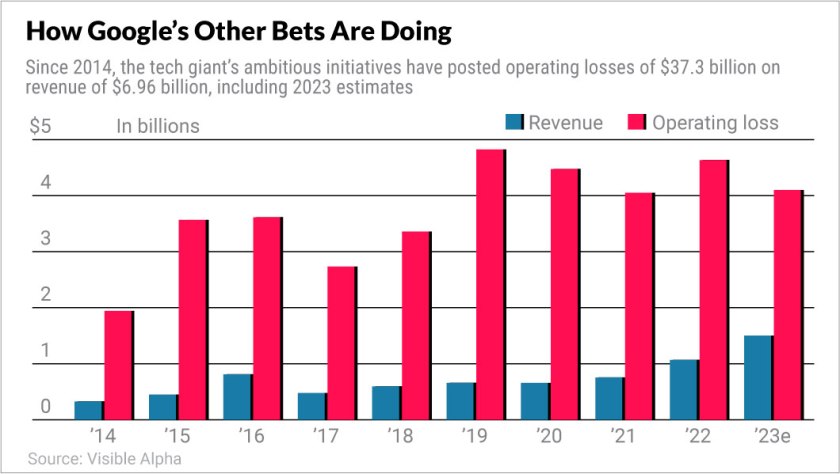
Alphabet’s recent response has been to generate more spin outs with real P&L statements and little or no safety net.
“The company was initially reluctant to let outsiders share the fruits of its investments or risk compromising intellectual property,” says Bloomberg, “including code that often relied on the work of other teams at Alphabet.”
More recently Alphabet executives decided it was better to provide autonomy than let promising technology whither on the vine.
To unintentionally hamstring research initiatives that do not directly support and may threaten their current business model is a dangerous legacy.
Most startups fail. With spin outs if that happens there will be no Alphabet job security at the end. Managers are less likely to be discouraged, consciously or subconsciously, because of a possible threat to the mothership.
Some of Silicon Valley’s biggest breakthroughs came from Xerox, a company that made copy machines. Xerox’s research and development lab in Palo Alto Research Center (PARC) invented ethernet, the graphical user interface and other personal computing essentials. Xerox PARC failed to commercialize most of the technologies, allowing Steve Jobs and others to do so first.
“The rise of Apple Inc. and the fall of Xerox Corp. became a parable about big companies failing to recognize the value of their own inventions.”
A Smarter Future
Let us hope that Alphabet, Microsoft, Apple and other technology giants spending many billions of dollars on R&D recognize the threat not only to their future and but to innovation. To unintentionally hamstring research initiatives that do not directly support and may threaten their current business model is a dangerous legacy.
“I do get a strong sense that Google has long since given up on breaking new ground,” an employee who requested anonymity told Bloomberg. “They’re pretty much just turning the crank.”
Xerox would be a much greater company today if had been more aware of the valuable inventions it had generated under its own roof and what to do with them.
Image source: investors.com via Gary Neill
 ipcloseup.com