
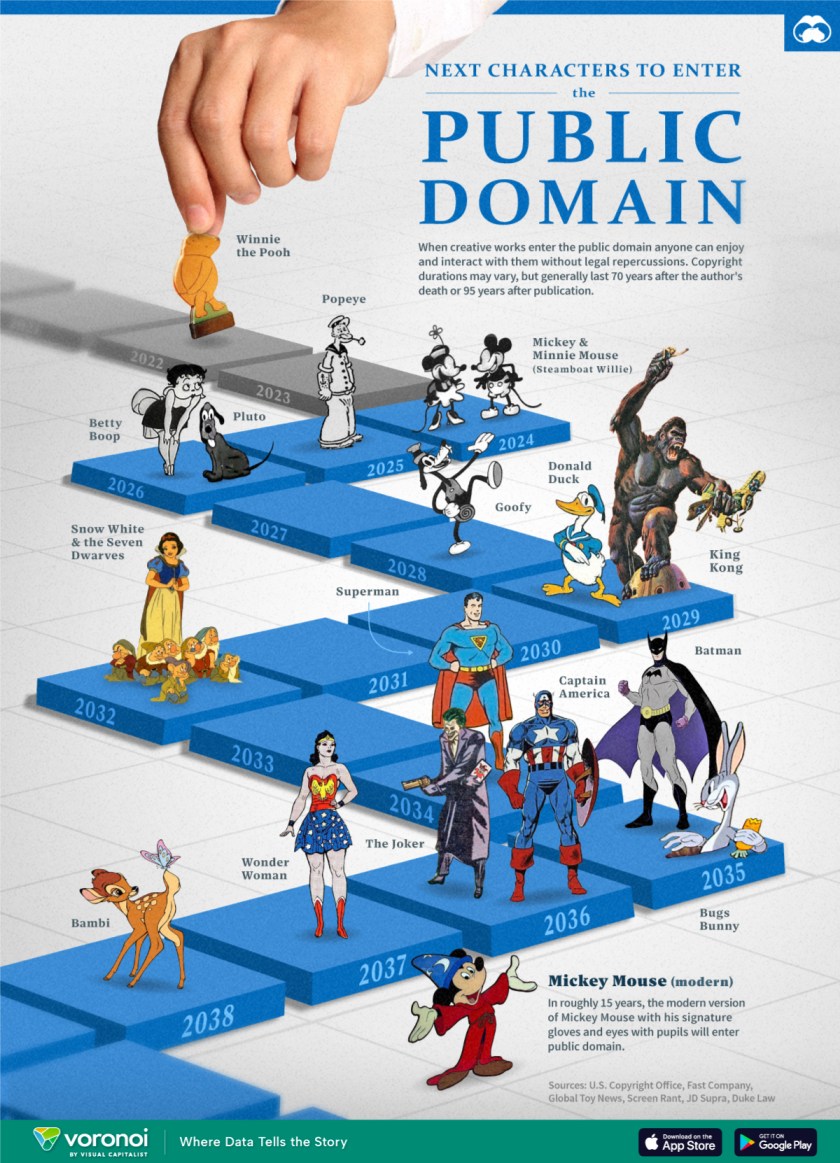
Iconic characters from Disney, Marvel and DC Comics (Warner Bros.) and other power brands will be entering the public domain at an alarming rate between now and 2038 (see graphic above).
But don’t expect to see these characters on screens or toys in the near future without the the imprinteur of the original owner. Businesses managing these multi-billion dollar assets have a strategy for maintain ownership and control.
Public domain means U.S. copyrighted content has reached its 95-year limit on exclusivity and in theory will be available for anyone to use without license. The devil, however, is in the IP details.
Newer Versions
The original Mickey Mouse and Steamboat Willie have evolved and new copyrighted versions of them exist, which will not expire for some time. Also Mickey and company are protected by multiple trademarks, which never expire as long as they are used and enforced.
Is this approach fair? It depends who you ask. Like some of the pharma companies who extend patents on current drugs or reformulate them for extended patent life, brands and publishers with franchise properties like Mickey Mouse are reluctant to relinquish IP rights if they don’t have to. In fairness, they have a huge capital investment.
 “Even when Mickey Mouse enters the public domain, don’t expect to see a flood of off-brand Mickey Mouse content anytime soon,” says Professor Stacey Lee, a lawyer and business law expert with Johns Hopkins Carey Business School. Lee anticipates Disney will continue fighting to protect its intellectual property as vigorously as ever.
Only the earliest version of Mickey Mouse appearing in Steamboat Willie will be entering the public domain. “The image of Mickey from Steamboat Willie looks very different from the typical Mickey Mouse we see today,” Lee said.
“Disney has also taken to modernizing the character over the year, giving him bigger ears, giving him pupils, and different shorts.” Lee says Disney still retains rights to all later iterations of Mickey and to any associated registered trademarks, such as the Mickey Mouse ears used in the Disney logo.
“These measures help Disney extend its copyrights and cement the company’s association with the character,” says Lee. Trademarks, which do not expire as long as they are in use, are another way to maintain control of a character.
Ultimately, it is unlikely that many competitors or would-be artists will be willing to challenge Disney for ownership of Mickey Mouse, even if they are in the public domain. Mattel and Barbie use similar tactics to assert ownership of their rights.
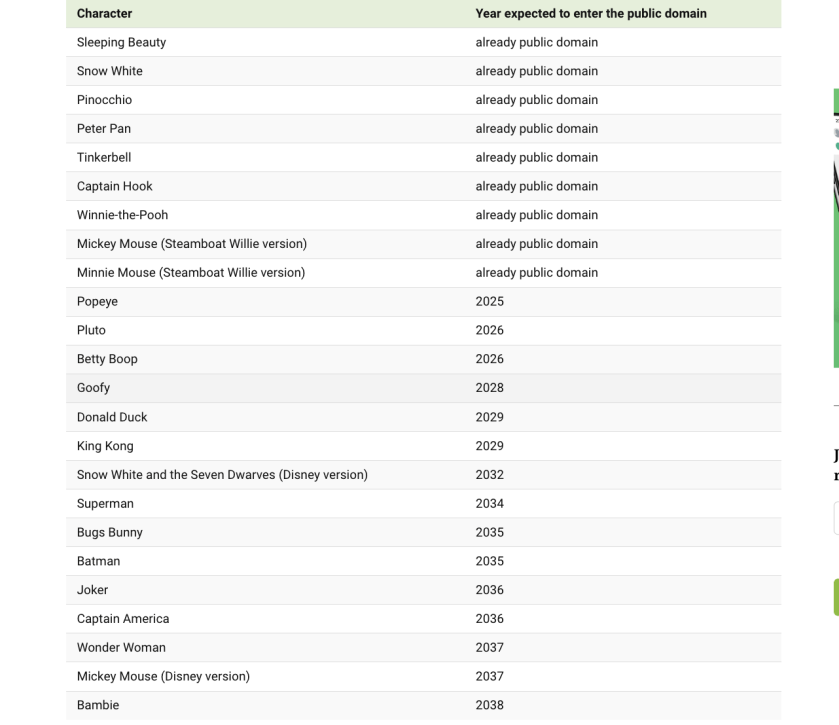
The copyright on many of DC Comics’ stars—like Superman, Batman, the Joker, and Wonder Woman—will expire in the 2030s (see list below).
Pushing the Boundaries
Emerging AI-driven services like DALL-E2 and ChatGPT are likely to push the boundaries of current copyright and intellectual property laws. The legal definitions for copyright, trademark, and other terms for intellectual property rights are not well suited for AI-generated works. Copyright protection requires work to be original and creative.
“The image of Mickey from Steamboat Willie looks very different from the typical Mickey Mouse we see today”
“How do we determine if an AI-generated work is original and creative?” asks Lee. “Does it matter if the AI uses existing data that may be combined in new ways? If I put a prompt into ChatGPT and it cranks out a haiku or poem, is that mine? Do I own it or does the AI company?”
Furthermore, I would add, Should one or more content providers used to train the helpful LLM receive a royalty, especially if the output generated is sold or licensed by a user?
Image source: Voronoi; VisualCapitalist
 ipcloseup.com