
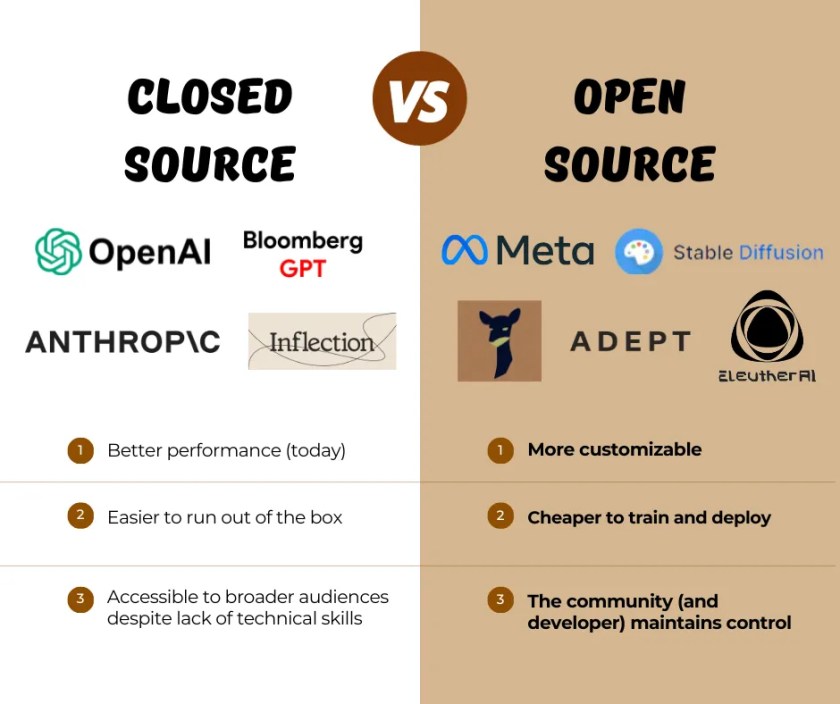
There is a lot riding financially on weather open or closed code AI will become LLM model of choice, or, if they can coexist. There are good arguments for and against.
ChatGPT’s parent, OpenAI, believes that closed code is safer, more likely to discourage bad actors, provide a lower learning curve and more reliable support. (OpenAI’s product, ChatGPT, is the least open of the LLMs).
Others believe that models, such as the open code suggested by Meta for its Llama LLM, are a more efficient and inclusive way to go, and ultimately provides broader access a larger range of users and developers.
Enter the Allen Institute for AI, the progressive nonprofit funded at least in part by Microsoft founder Paul Allen’s fortune. The Allen Institute for AI (AI2) believes even Meta’s proposed model does not go far enough, and sharing code openly leads to better control and easier customization.
Follow the Money
In my latest Intangible Investor column in IPWatchdog, I show why it make sense to follow the money when it comes to GenAI development. MSFT invested a total of $13 billion in OpenAI’s ChatGPT and other products. Supporting open code via AI2 are the Allen heirs, either sister Jody Allen, its foundation or other entities, which may still own as much as $42 billion of Microsoft shares, more than Bill Gates.
Read my analysis in IPWatchdog below.
The diversity of approach regarding AI code may actually be healthy for the nascent LLM ecosystem, generating innovation and safety and at the same time respecting patents.
But without more transparency and even less government oversight, I am afraid, we may be doomed to repeat the mistakes of the early Internet. Information access and accuracy don’t have to be over regulated to exist. Check out my piece in IPWatchdog below.
“The most recent example of that investment [in closed code AI],” writes Christopher Mims in Saturday’s the Wall Street Journal: Apple and Nvidia are in talks to join Microsoft in investing in OpenAI’s next round of financing, which would value the company at $100 billion.”
The greatest threat to OpenAI is Open AI
For many everyday applications AIs that are trained to do only specific tasks can be better and cheaper to run, says Julien Launay, whose startup uses Meta’s Llama to train small customized AIs for companies.
Image source: aspiringforintelligence; allenai.org
 ipcloseup.com