
In recent years design patents have come to have a more vital role in the intellectual property landscape.
Design patents protect the ornamental aspects of an invention, such as the design of a product or interface.
The look of a product, such as Apple devices or, is playing an increasingly important role in new product sales, but the aftermarket, especially for spare car parts like headlights, are an increasingly lucrative market that design patents help to protect.
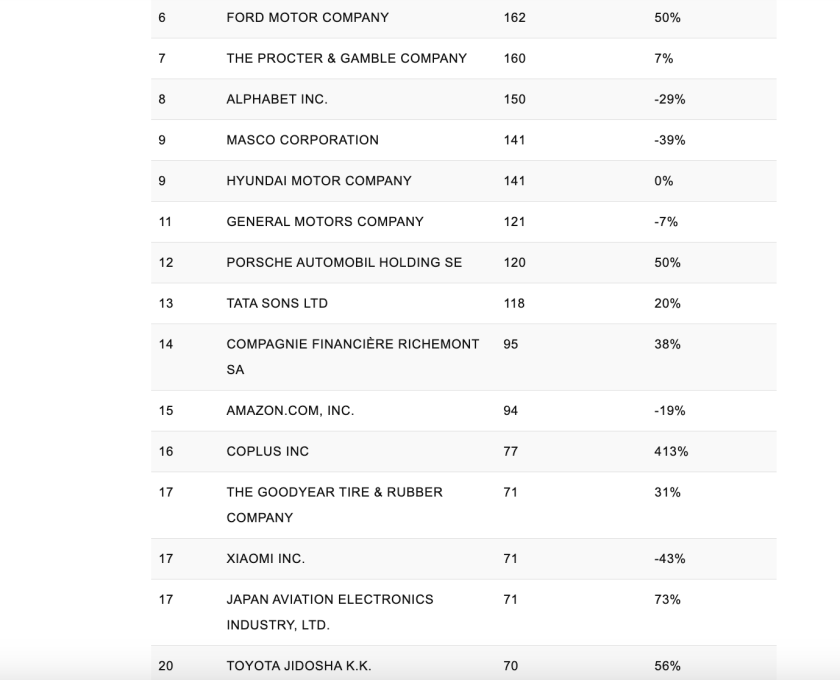
In the 2024 Design Patent 100 from Harrity LLP, some notable increases in patent grants for calendar years 2023 jump out, especially in the automotive industry.
Among the big gainers in design patents are Ford Motor Company, up 50% to 162, Porsche Automobile Holdings, up 50% to 120, Tata & Sons LTD (Jaguar, Land Rover), up 20% to 118, and Toyota Jidosha K.K., up 56% to 70 design patents.
AB Volvo was up 54% to 63 and Zhejiang Geely Holdings Group, Volvo’s Chinese parent, was up 100% to 62.
Tire manufacturers also contributed to the trend. Tire pattern design, always important for high performance, has apparently become more of a differentiator, and an element that can today be more readily protected.
If design patents are even slightly more difficult to obtain, their value could increase.
Goodyear Tire & Rubber Company design patents were up 31% to 71 and Japanese Bridgestone Tire was up 78% to 66 design patents. Sumitomo Rubber Industries rose 94% to 60. Percent tire and auto increases may be based on initially low numbers, but up they are.
Automobile manufacturers with no increase or a decline include Bayerische Motoren Werke AG (BMW) -6%, Hyundai 0%, Stellantis (Chrysler-Fiat-Maserati) -2% and General Motors -7%.
Counterfeits Matter
“Counterfeits are a huge issue in the aftermarket for replacement parts in the auto industry,” Finnegan partner, Elizabeth Ferrill, who focuses her practice on all aspects of design patents, including prosecution, counseling, post-grant, litigation, and appeal, told IP CloseUp.
The secondary market is increasingly lucrative for manufacturers and licensing, and design patents help to assure this revenue stream, says Ferrill.
As to why some companies are up significantly and other flat or down, Ferrill theorizes that it depends on where a particular business is with a new product cycle.
She did not believe that the LKQ v. GM case will have much impact on design patent grants, although it may be too early to tell.
Obviousness Bar Now Lower
On May 21, 2024, the Federal Circuit issued an en banc decision (full court, instead of the typical three-judge panel) in LKQ Corp. et al. v. GM Global Technology Operations LLC, writes JD Supra, overturning the long-standing obviousness test for design patents.
The court ruled that the obviousness test for design patents should be similar to the test for utility patents. “This presents a potentially significant shift for design patent law, and makes applications potentially easier to reject.”
It’s unclear how the ruling will impact applicants. However, if design patents are even slightly more difficult to obtain, their value could increase.
Hidden Value of Protection
In general, enforcement of design patents is somewhat limited. Design patents only protect the appearance of an item, not its structural or utilitarian features.
A design patent protects the ornamental design of a functional item. In the automotive industry, this can include the unique shape of a car’s body, the design of its headlights, or the layout of its dashboard. Unlike utility patents, which protect the way an invention works, design patents protect how an invention looks.
The value of a design patent often lies with owners who, similar to trademark holders, can stop others from making, using or selling a product which looks like the infringed one. However, occasionally, damages can be collected for abuse or a license negotiated.
Nike, Samsung and Apple, decidedly different businesses all with a strong retail presence, hold the most U.S. design patents.
Image source: Harrity LLC
 ipcloseup.com