
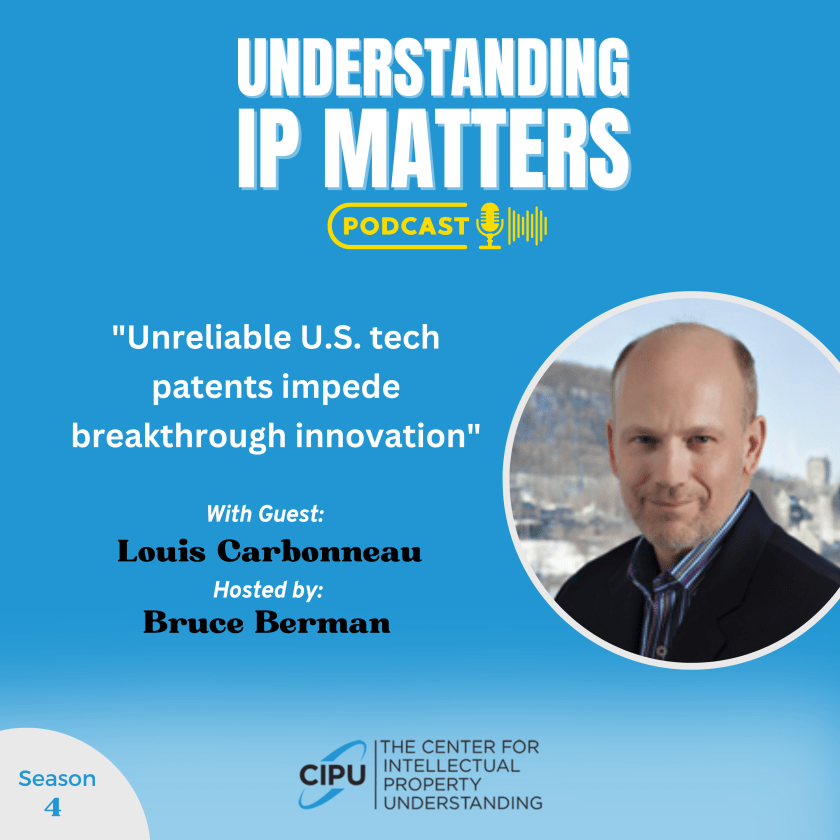
A leading patent expert and former Microsoft licensing director says weak, uncertain patents are hurting businesses, disincentivizing creators and discouraging investors – a recipe for disaster if the U.S. wishes to compete and maintain a robust economy.
Louis Carbonneau, CEO of Tangible IP, a patent advisory firm, appears on the latest episode of CIPU’s ‘Understanding IP Matters’ podcast. The episode is titled: “Unreliable U.S. tech patents impede breakthrough innovation.”
“It’s so hard to transact patents due to the doubt over their validity,” say the Seattle-based broker, who is also a lawyer.
Carbonneau asks “if you could imagine this doubt in real estate transactions, where you buy a house and you’re never quite sure whether the seller has the right title or is the verifiable owner, and demand is suppressed, the real estate industry would slow to a crawl overnight.
- “There’s not a single industry that could get away with that, except if it were the government and here, that’s why it’s still happening.
And then it’s, it’s just a charade because you have one arm of the government You know, charging you a lot of money to issue a patent in the first place and another arm, which is an offspring. - “The first one is charging you, you know, in order of magnitude more to have the second one tell you that the patent was never valid in the first place. In any other industry with people would be in jail for doing this.”
Carbonneau, an investor who is named on several patents, says his firm receives about three or four patent portfolios for consideration every day but rejects 99% of them. He believes that only about 1% of the patents up for sale today may have some value on the secondary market.
A sad state of affairs for any financial assets, even those not typically reflected on company balance sheets.
He believes we got here through the influence of big tech for passage of legislation detrimental to innovatin that would lower its costs, case law that is out of touch with current business reality, as well as the Patent Trial and Appeal Board (PTAB), which has come to invalidate up to 85% of USPTO-issued patents that come before it.
- Carbonneau continues: “A lot of the infringement by large companies is innocent. I was at Microsoft for 15 years. I know how large companies work. There’s usually a memo that tells people don’t look at third party patents because we don’t want to be in a situation of willful infringement. So people are flying blind for the most part and reinventing what others have done in many, many cases.
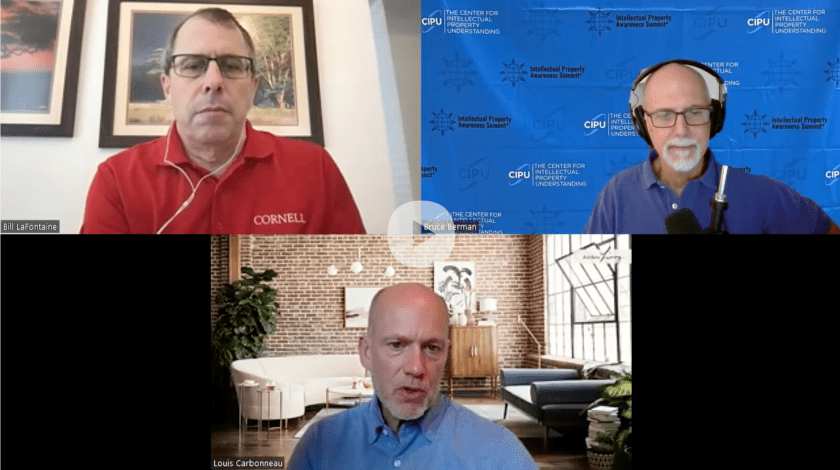 Carbonneau appeared in Ep2, S3 of ‘Understanding IP Matters’ with Bill LaFontaine, IBM’s former General Manager of Intellectual Property and VP of Research Business Development
_______________ - “Then they’re being told that they infringed because they reinvented the same darn wheel. So, the predatory aspect is not in terms of going out and looking for something useful and then they’ll say, oh, we’ll copy it.
- “They actually, in most cases, come up with the same invention, but years after someone else had been there. The predatory aspect is when they decide that they’re going to use the system, essentially, not to recognize other people’s IP rights. And that that’s the part that is really detrimental to the U S economy.”
Carbonneau, who publishes IP Market Updates, a monthly newsletter with 20,000 subscribers, concluded with his belief the the bills that were before Congress in 2024 that address patentability and restore injunctive relief, and are likely to be reintroduced in 2025.
“They can make a huge difference in restoring the patent system and putting U.S. businesses in a better position to compete.”
Read the full summary of my interview with Louis Carbonneau on IPWatchdog.
Or listen to it on the platform of your choice. Request to be notified of new episodes.
Image source: CIPU; understandingip.org
 ipcloseup.com