
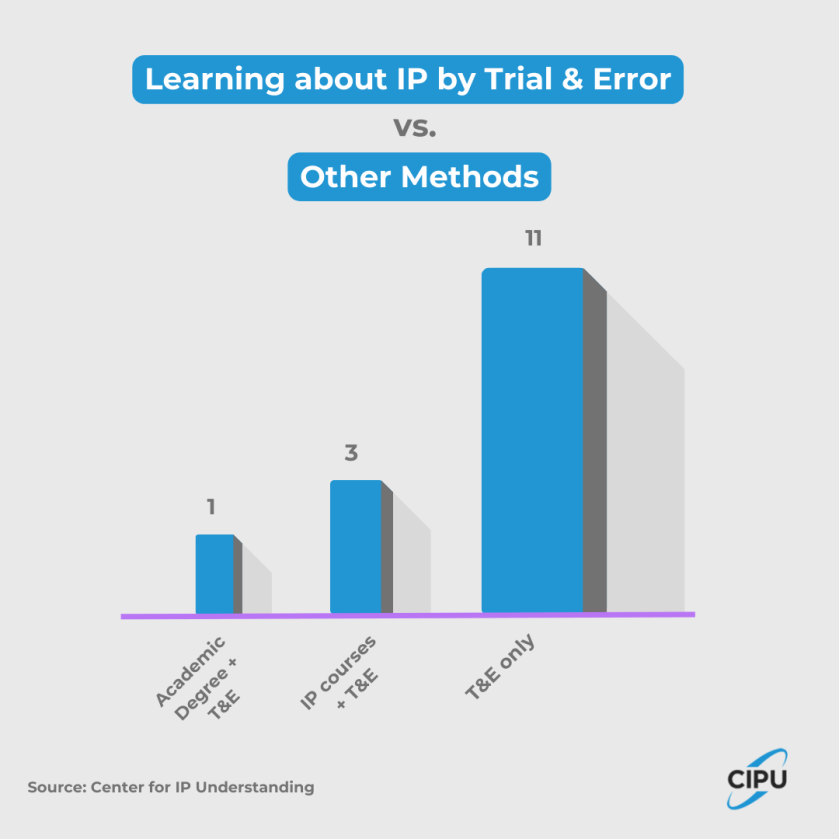
The majority of managers and entrepreneurs who work with IP rights interviewed for a new research report from Center for Intellectual Property Understanding (CIPU) say they were underprepared for conducting business with IP rights and learned mostly on the job by trial and error.
The report’s 15 interviews reveal serious gaps in patent, trademark and copyright education.
Learning about the use of IP rights is frequently lacking and inefficient for some managers and entrepreneurs, making it more difficult for them to do their job effectively.
“Despite the clear relevance of IP to their STEM backgrounds, they had to seek out or develop this knowledge on their own, either through personal initiative or by gaining experience in the workplace.”
Based on extensive interviews with 15 managers and entrepreneurs who either use, manage or work with patents, copyrights, trademarks or trade secrets as central to their job, the CIPU report found most are ill-prepared to deal with IP rights in a business setting. Much of their IP education appears to take place on the job, often though trial and error, with little formal guidance.
‘Manager and Entrepreneur IP Experience: The Limitations of On-the-Job Learning’ was compiled by the Center for Intellectual Property Understanding, a nonprofit founded in 2016, to better identify when and how various professionals learn about IP rights and the IP system, and what they believed about their job preparation.
Key trends derived from the interviews:
- Most professionals first encounter IP concepts on the job, highlighting a need for formal academic exposure
- STEAM graduates face a steep learning curve in navigating patents, copyrights, trademarks and trade secrets
- Current IP resources are often written “by lawyers, for lawyers,” leaving non-legal professionals without practical tools
- Professionals must adapt to differing IP laws and platforms in an increasingly globalized market
- Professionals working with IP rights who sought IP knowledge during their studies said they were better equipped for career success
“To explore the educational and professional development experiences of those working in this diverse field,” says the report, “CIPU conducted a series of fifteen in-depth interviews with IP professionals. The participants represent a broad range of expertise, roughly evenly divided among the appropriability regimes of Patent, Trademark, and Copyright work—and several had applicable experience across multiple areas.
“These professionals were asked to share their IP educational and career journeys, their first encounters with IP rights, and the motivations that drove them to deepen their understanding of these rights. They also discussed the common issues they face in their daily work, how they navigate these challenges, and the advice they would give to the next generation of innovators in their field.”
Common Themes
A common theme that emerged from interviews was the absence of non-elective IP courses throughout their formal education, despite the clear applicability of their STEM backgrounds to patent-related work. For many, the lack of IP education at any stage of their academic journey came as a surprise, especially in retrospect, given the central role IP plays in their professional lives.
“Their testimonies highlight the need for more structured and mandatory IP education in STEM fields, so that future generations of professionals are better equipped to navigate the complexities of intellectual property from the outset of their careers.”
“Most of the other professionals interviewed echoed a common refrain: IP education was either completely absent, or available only to those who already knew its value. Thus, learning was an on-the-job experience, often as a result of a transaction or a dispute.”
Across the board, these professionals exemplified a “learning by doing” approach when it came to IP. Despite the clear relevance of IP to their STEM backgrounds, they had to seek out or develop this knowledge on their own, either through personal initiative or by gaining experience in the workplace.

Their testimonies highlight the need for more structured and mandatory IP education in STEM fields, so that future generations of professionals are better equipped to navigate the complexities of intellectual property from the outset of their careers.
Tap here to read or download ‘Manager and Entrepreneur IP Experience: The Limitations of On-the-Job Learning.’ Direct quotes from those interviewed are included.
Tap here to read Steve Brachmann’s excellent summary and analysis of the report in IPWatchdog.
For previous CIPU summary reports, go here.
Image source: CIPU, understandingip.org
 ipcloseup.com