
True innovation is often disruptive. For breakthrough inventions and expression to appear there needs to be a system of IP checks and balances that rewards creators and investors fairly and levels the playing field.
Without reliable IP property rights and the power of injunctions to prevent an infringer from ignoring litigation, a literal handful of businesses, highly capitalized and well positioned IP aggregators, by default, will determine what is innovative.
That will be what they and their shareholders can most benefit from, not innovation, business or society.
__________
That is the perspective of Jonathan Barnett, author of a provocative new book, The Big Steal: Ideology, Interest and the Undoing of Intellectual Property that is less unique for what he says than the clear technology, economic and societal context he conveys them in.
It is truly a book for everyone to understand the strengths and weaknesses of the U.S. IP system, which, in case you hadn’t noticed, has been in dangerous decline for more than a decade.
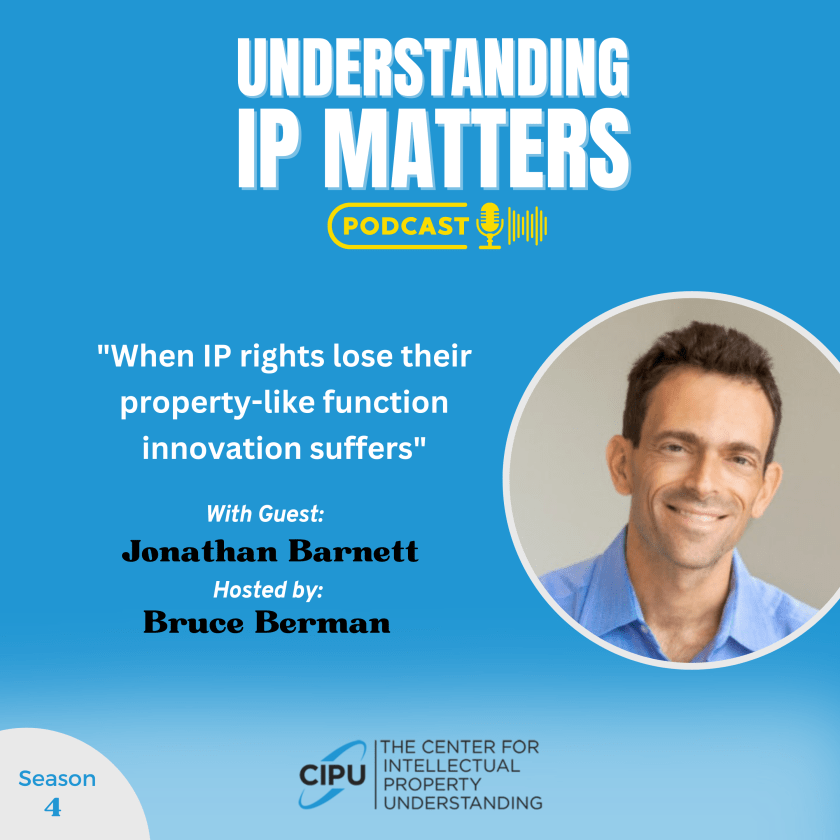
Barnett, who heads the tech, media and entertainment law program at USC, is Bruce Berman’s guest on the latest episode of Understanding IP Matters, the Feedspot #1 rated IP podcast. The episode dropped today.
__________
Barnett is moderator and speaker on the first panel of the IP Awareness Summit, being held by CIPU in conjunction with Dolby Labs at Dolby’s headquarters in San Francisco on April 24th. Three IPCU readers are eligible for a 50% discount while they last. Use code IPAS25CORP50 or IPAS25NFP50. Space is limited.
_________
Barnett’s words:
- “It’s the confluence of these two forces [abuse of fair use and academic myopia] that have reset our IP system in a way that has distorted our innovation ecosystem.
“It doesn’t kill innovation, but it only allows one business model to persist, and over the long term this is not going to be good for the ecosystem as a whole, because we’re going to hurt the small firm innovator, we’re going to hurt the individual creator. That won’t even be good for the platform.”
- “We want the market to be able to choose freely among different industry sectors rather than that choice being distorted by arbitrary differences in the treatment of property rights.
“You skew the playing field to benefit some of the largest companies in the world who have not, for the most part, contributed to the development of the technologies that enable devices like the smartphone. And that’s why you get this situation that seems quite paradoxical.
“How could it be that the largest, some of the largest tech companies in the world Don’t like patents. They don’t like patents because in many cases because they are a net user of technology. They’re an integrator and aggregator. They’re not the originator of that technology.”
- “It would be helpful to convey to those with the ability to impact policy to reaffirm an awareness that tech markets and content markets are really not so different at the end of the day from just your regular old physical goods markets. People need to get paid [for what they produce]. Investments have to be secured and made whole.

“These require property rights. And that logic is familiar, it’s not controversial in the physical goods area with some adjustments. For intangible goods that logic should also prevail.”
To read a summary, listen to or download the episode, When IP rights lose their property-like function, innovation suffers, visit IPWatchdog podcasts, here.
Barnett will moderate a timely panel at the IP Awareness Summit being held by CIPU in conjunction with Dolby Labs at its headquarters in San Francisco on April 24th. A few discounted tickets are still available. Contact: explore@understandingip.org.
Image source: CIPU; UnderstandingIP.org
 ipcloseup.com