
Research conducted by the World Intellectual Property Organization (WIPO) focusing on how international business programs implement IP education confirms many of the Center for Intellectual Property Understanding (CIPU) findings. But with significant twists.
CIPU’s summary report, conducted in 2021, was the first known research about IP education provided in U.S. MBA programs. There are some notable differences between the WIPO and CIPU research.
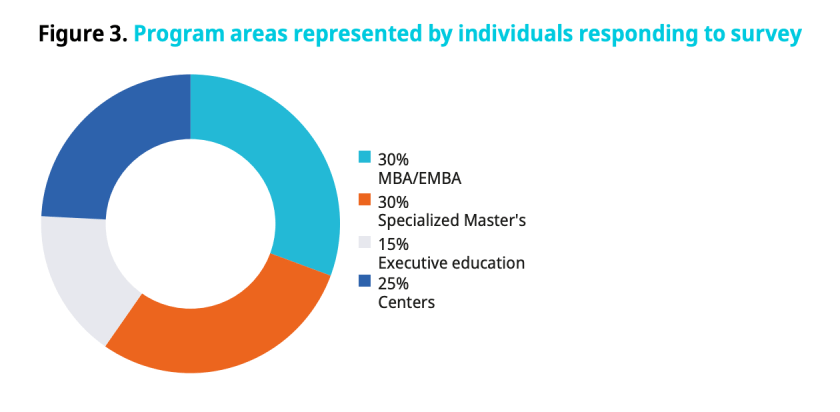
WIPOs survey, Intellectual Property Education in Business Schools – A Global Perspective, looks at business and executive education programs, as well as international business programs, for curriculum content and availability. Only 30% of the schools were MBA-management programs (see graph above).
Key findings from the WIPO survey:
- IP is taught to some degree in most surveyed business programs: 89 percent of respondents across four program areas said that one or more IP topics are incorporated in their curriculum in some way.
- The level of learning predominantly targets a basic awareness of the topic (42 percent of
 respondents) although we do see differences across program areas.
 - Few schools have courses or course modules dedicated solely to the topic of IP, although the subject is integrated into courses on other topics.
CIPU’s less formal summary report, Intellectual Property Education at Business Schools: An Evolving Landscape, published in 2021, found a similar disconnect between curriculum offerings and functional business requirements.
“Students enrolled in many in these programs are future Global 1,000 executives, financiers and dealmakers… “You would think schools would better prepare students for the IP challenges they will face.”
However, it also determined that as many as one-third of the top 20 U.S. MBA-management programs offered no courses at all, and none of the programs stipulated a single IP course as a requirement for graduation.
“Students enrolled in many in these programs are future Global 1,000 executives, financiers and dealmakers,” one observer told IP CloseUp in responding to the two studies.
“You would think schools would better prepare students for the IP challenges they will face. It’s no longer a world of bricks and mortar; learning on the job virtually from scratch is inefficient.”
WIPO received survey responses from 62 individuals representing 35 business schools (a response rate of 39 percent among 161 invited individuals and a 64 percent participation rate among the 55 schools that indicated an initial interest in this project). 52% were in Europe and Asia.
Findings of the CIPU Report:
Among key findings of the CIPU report, Intellectual Property at Business Schools:
- Almost one-third of business schools offer only one course
- None have a required or core IP course
- Lack of data, especially on soft IP assets such as copyrights and trade secrets, make it difficult for programs to support the IP education argument
- Some B-school educators do not believe that IP is best taught by lawyers
For a PDF of the WIPO survey, tap here.
To see CIPU’s report, access the link in this sentence to the CIPU Reports Page.
Image source: WIPO
 ipcloseup.com