
A new study of people’s attitudes to towards artificial intelligence reveals continued skepticism on the part of some of the most highly developed nations, and strong adoption among those countries striving to compete.
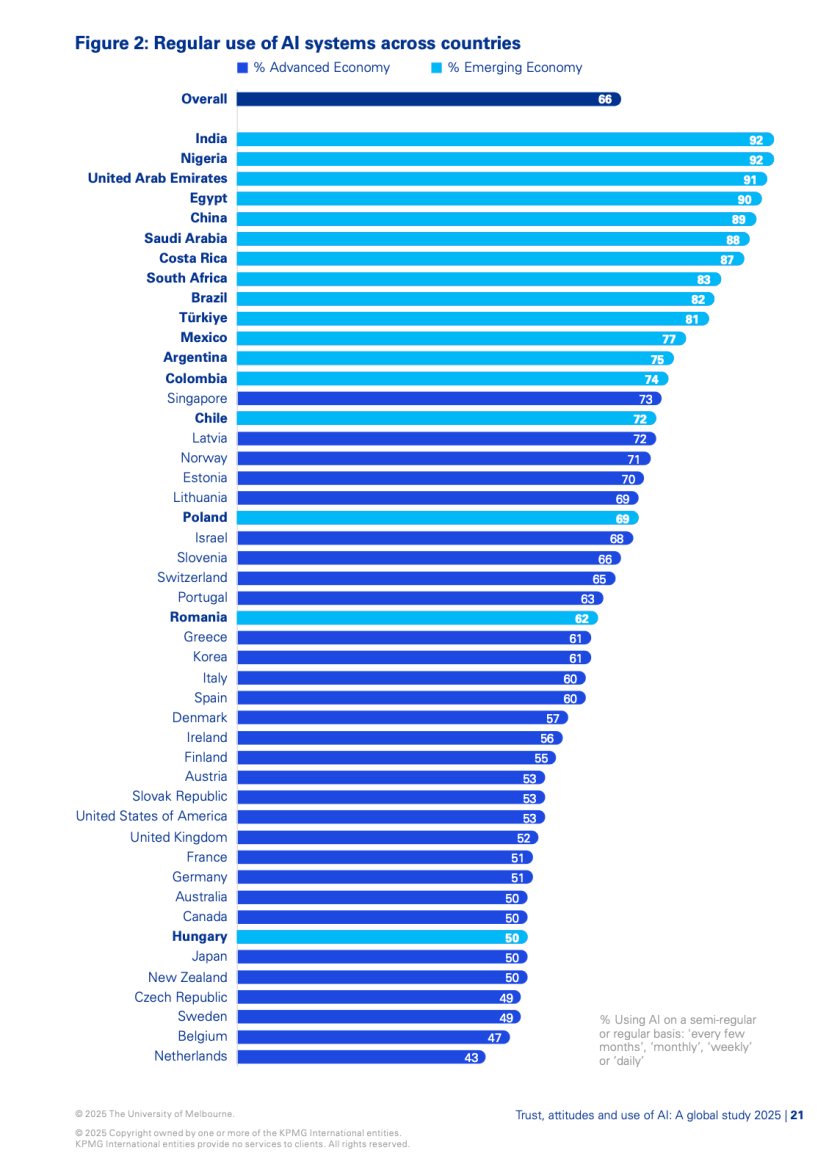
The top 13 adopters in the study are all considered emerging economies. 29 of 32 of the slowest adopters are advanced economies (see bar graph).
“Trust, Attitudes and the Use of Artificial Intelligence” is a research report issued recently by KPMG in conjunction with the University of Melbourne. The 118-page study covers 47 nations.
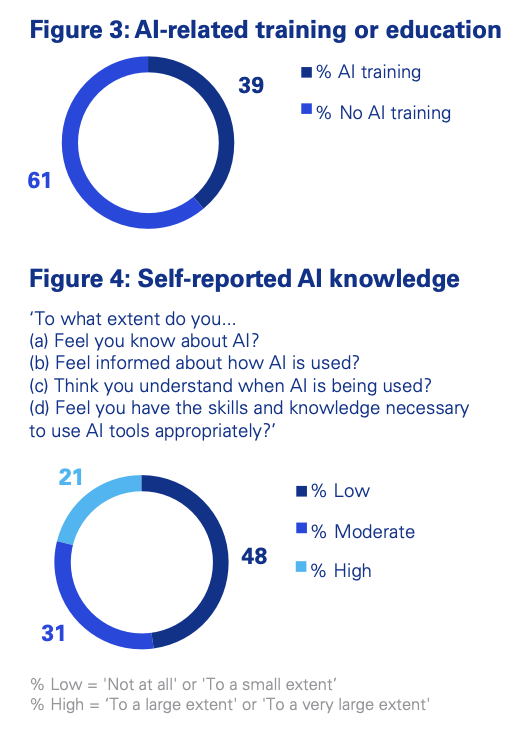
38% of responding Canadians and about 43% or U.S. residents responding said they have only some moderate knowledge of AI use, a margin lower than the 52 per cent global average.
“The ability to use AI effectively and knowledgeably is becoming a critical skill in today’s economy,” said Benjie Thomas CEO with KPMG Canada. “AI will re-shape the future of nearly every organization, so it’s imperative for [Canadian] institutions to prioritize AI training and education at all levels – in schools and in the workplace.”
Nations with the poorest record of AI adoption are among the most highly developed economically and technologically.
The nations with the most adoption, as shown in the bar graph, India and Nigeria at 92%, followed by UAR, Egypt, China, Saudi Arabia, Costa Rica, South Africa, Brazil and Turkey.
Conclusions include:
-
Trust in AI systems remains a significant challenge: over half (54%) are wary about trusting AI
-
Two in three (66%) intentionally use AI on a regular basis and three in five say they can use AI effectively. However, most (61%) have no AI training
 and half report limited knowledge. People in emerging economies report higher regular use (80% vs 58%), training (50% vs 32%), knowledge (64% vs 46%) and efficacy (74% vs 51%) than those in advanced economies.
 -
There is a strong public mandate for AI regulation, with 70% believing regulation is necessary. However, only 43% believe current laws are adequate.
-
Emerging economies are leading in employee adoption with 72% using AI regularly compared to 49% in advanced economies. Two in five believe AI will replace jobs in their area.
It is interesting to note the nations will the poorest record of AI adoption, in ascending order on the graph with the worst first:
Netherlands, Belgium, Sweden, Czech Republic, New Zealand, Japan, Hungary, Canada, Australia and Germany.
The U.S., despite more than $600 billion collectively invested in 2024 and 2025 GenAI by Microsoft, Alphabet, Meta and Amazon, is at 53% adoption, in the lower half of the surveyed group.
The top 13 adopters in the study are all emerging economies. 29 of 32 of the slowest adopters are advanced economies.
Go here to access the full report. It’s worth perusing.
Image source: KMPM; University of Melbourne
 ipcloseup.com