
When it comes to IP rights, confusion reigns. Some people believe weaker IP systems that encourage uncertain patents result in lower drug prices and more widely available treatments.
Understanding how innovation works hand-in-hand with investment and ownership in the U.S. and elsewhere is no longer important – it’s critical.
In the season five premiere of “Understanding IP Matters,” CIPU’s popular podcast, Henry Hadad talks about the forces affecting IP rights, such as patents, copyrights and trade secrets, and the need to inform audiences about how the system works and who it benefits.
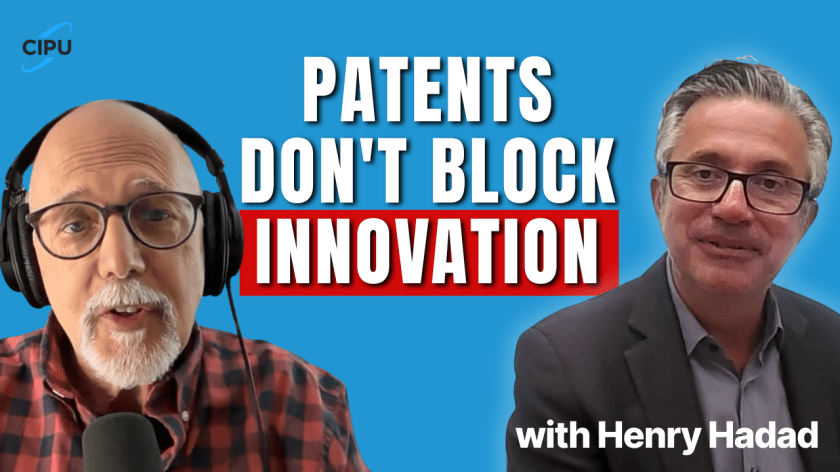
On Ep1 of season five of UIPM, “Patents don’t block innovation, ignorance does,” which dropped last week, Hadad, Senior Vice President & Deputy General Counsel, Innovation Law at Bristol Myers Squibb, puts IP rights into a context policy makers, consumers and investors can readily understand.
Hadad, whose father and uncle were successful songwriters, the latter of whom won an Oscar-winner in the 1970s, believes that confusion about the purpose and reliability of IP rights, patents, copyrights and trade secrets, slows breakthroughs and discourages investment.
Below are some excerpts from the podcast, for the first time this season, in video and audio:
- One of the key drivers of the creative and innovative engine of our country is the role that IP has played since the inception of our country. That incentive, if you do something great, whether it’s a creative act or an invention, you can protect it from being appropriated for a period of time. You’ve now taught the world how to do it; now someone can improve upon it.
As current President to the Intellectual Property Owners Association Education Foundation and on its board of directors, Henry Hadad has received many industry honors.
- Exceeding basic [university and agency] research has been an incredible boon to healthcare around the world. None of these academic institutions, nor frankly most startups, really have the ability to take a drug that’s been discovered and then ultimately bring it through development into the approval process ,and get it out to patients. That’s where a lot of the larger biopharma companies come in.
- Investors need a meaningful period of exclusivity such that they know they can continue to invest in that product. And remember, Bruce, it’s not just that initial investment toward that first approval. Many products, particularly biologics, require continued investments… to make sure that you go from the melanoma indication to the lung cancer indication to the head and neck cancer indication.
- If you can’t just make the music, it will be taken from you if it’s more expensive than people are willing to pay… There was a change in cultural norms that is influencing this generation. It’s pretty clear that over the past 20 or so years, several large tech companies find the patent system more burdensome than helpful, because of their business model, which is new hardware, new software every couple of years.
Tap here for the video of Patents don’t block innovation, ignorance does.
Tap here for the audio. Your comments are welcomed
Look for new episodes every other week. Subscribe to “Understanding IP Matters” on YouTube, Buzzsprout or the platform of your choice.
Images source: CIPU; understandingip.org
 ipcloseup.com