
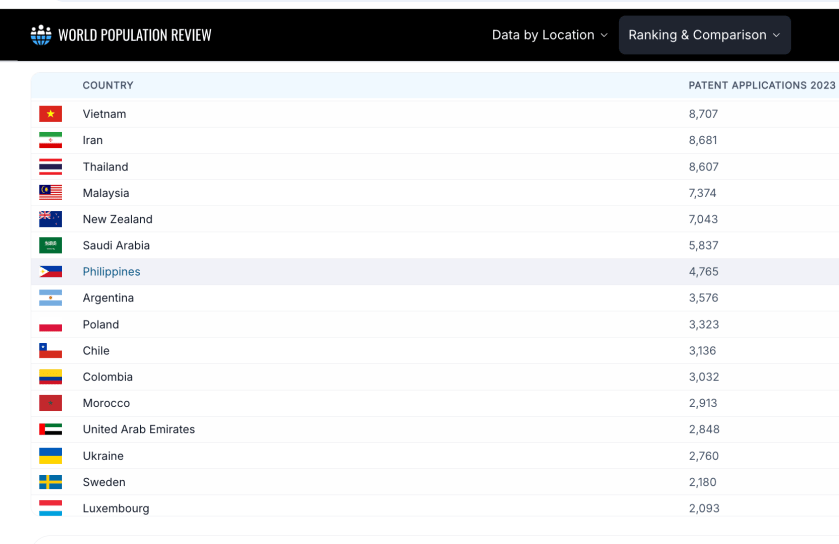
Most of the 3,244,273 patent applications in 2023 were filed by the usual suspects, China, the U.S., Japan, et al., but an increasing number are coming from nations who a few years ago filed few or no patents. What has changed?
It is widely agreed that patent quantity is a poor indicator of innovation or value. Context is key. Where patents on inventions are granted and in which industries and technologies can change their meaning. Also, how the patents are used, e.g. for licensing or defensive purposes can alter their relevance.
Patent applications are an indicator of national interest in new technologies and a desire to play economically, and strategically, on a global stage.
Apps vs. Grants
World Population Review’s “World Intellectual Property Indicators by Country 2025” is a strangely useful resource. It shows patent applications for 2023, which are an even less reliable indicator than those granted, are growing rapidly in some nations, with filing up 100% or more.
But without context of where the patents have been filed (likely in the home nation or a PCT filing), and which are likely to be granted on for inventions likely to be commercialized, it is difficult to assess their meaning.
“The data suggests that the patent filing landscape is increasing for some previously low activity nations and that some of those nations we would expect to lead in patent filings are either being more selective or are feeling that some IP rights are less important.”
Useful Data
All of this aside, I found the WPR interactive patent map useful, especially when looking at the filing activity of less developed nations. For example, the top 20 patent filers are mostly the usual suspects, with China leading the U.S. almost 3 to 1 in applications. Little surprise there.
However, from rankings 21 to 36 we have some surprises. Nations like Vietnam, Iran and Thailand show significant numbers of patent applications. Sweden was surprisingly low (2,180) for such a well-educated, industrialized and research-oriented nation. Spain had only 1,318.
Brazil, with a population of 212 million people, came in with a somewhat surprising 24,759 applications, more than both the UK 19,485 and France 14, 746.
Australia totalled 32,284 apps with a population of 27 millions, while Russia, with 143 million people, filed 26,924.
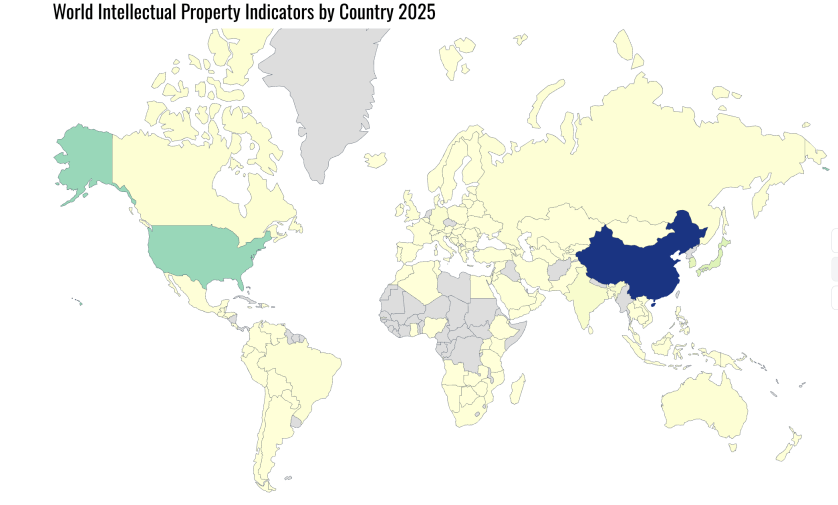
Tap here to use the WPR interactive patent application chart above. (Included is an option to view patent grants.)
Estonia, a small but technologically sophisticated county with a relatively robust economy had only 15 applications. Many countries had none, among them, Cuba, Paraguay and Panama, as well as many Central and Western African nations had none.
In 2022, global patent applications were even higher, 3.46 million and China more than tripled the U.S. in filings.
- While it is difficult to discern definitive findings the data suggests that the patent filing landscape is increasing for some previously low or no-filing nations and that some historic leaders in patent filings are either being more selective, believe that some patents today (such as those on software or related to algorithms) are simply more difficult to secure, defend and monetize, or, simply, less necessary to obtain.
No Political Affiliations
World Population Review is an independent organization without political affiliations. Provides datasets, maps, data visualizations, charts, and graphs on environmental issues. Investigates political, social, economic, religious, and cultural thoughts, beliefs, and values in over 100 different countries. WPR is currently generating 7.5 million views per month.
“Most demographic data is hidden in spreadsheets,” reports WPR, “behind complex APIs, or inside cumbersome tools.”
World Population Review’s goal is to make this data more accessible through graphs, charts, analysis and visualizations. Its website says that it also strives to present the most recent information available.
Image source: worldpopulationreview.com
 ipcloseup.com