
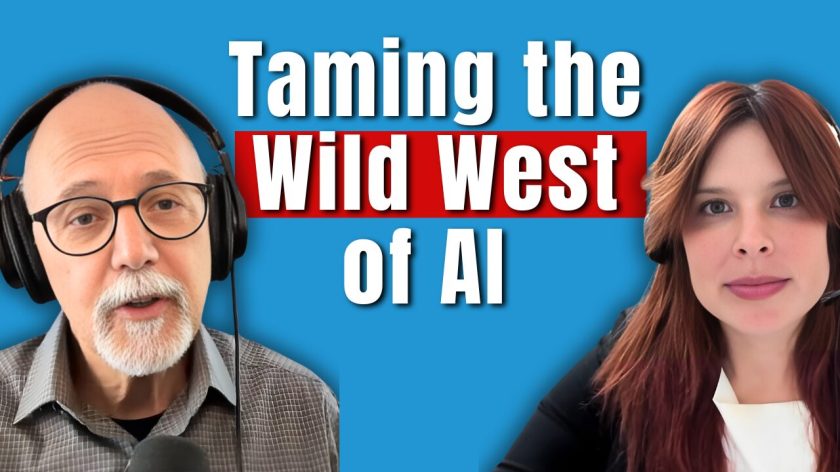
In the mostly lawless land of artificial intelligence, businesses can not wait for government guidelines or new laws to proceed with adoption, according to AI and IP expert, Allison Gaul. They must feel their way, relying on ethics, fairness and a eye on risk mitigation.
AI developments are evolving daily and “at this pace regulation could be years away.” Companies need to act to develop their own risk, compliance, and ethical standards that ensure sustainable innovation and responsible IP use, directives unlikely to come from the states or DC, even if the come from well-intended organizations.
Trump’s Executive Order
President Trump signed an executive order on Thursday that seeks to limit the ability of states to regulate artificial intelligence while attempting to kill some existing state laws. The executive order is likely to be challenged in court. Tech policy researchers say the Trump administration cannot restrict or preempt state regulation without Congress passing a law.
The order aims “to sustain and enhance the United States’ global AI dominance through a minimally burdensome national policy framework for AI,” according to text published on the White House website.
Uncharted Terrain
On the current episode of Understanding IP Matters, Allison Gaul, a patent attorney and former Ms. District of Columbia, discusses the data acquisition strategies pursued by various AI platforms and how they impact businesses and consumers.
Gaul advises businesses and evaluates digital products for BCG X, a build and design consulting firm, with an eye toward intellectual property strategy, value creation, and legal risk.

On the episode, Gaul provides tips for AI startups, investors, and companies using AI, such as the importance of a publicly facing policy of responsible AI use and compliance.
Listen to the podcast, Taming the Wild West of AI,” S5, Ep5 on the platform of your choice.
Watch this latest episode on YouTube.
Gaul and host Bruce Berman discuss:
- Insights into what venture capitalists want to see when investing in AI startups. “They want to know you have a maturity level with respect to your AI risk understanding, your compliance policies, so you’re not going to create substantial problems down the road.”
- Why focusing on a proprietary single large language model (LLM) may be too expensive or limiting. Gaul believes we’re starting to see a transition there. “As AI continues to evolve, we’re going to see people drifting to these targeted use models that have been trained on highly specific data sets.”SLMs are More Efficient than LLMs
- Targeted or small models are “more cost effective for companies to build on that those from businesses like ChatGPT and the Anthropics.”
- Gaul has recognized a recent shift in IP protection for small AI-driven companies: “I’m seeing people leverage more trade secrets rather than going for patenting because a lot of the magic is in your data set and that’s not individually protectable.
- Trade secrets are especially popular for the AI offerings of these companies because they “really do not want to disclose how they did it, what they trained it on or how they’re leveraging it until they’ve got enough users in the tank that they can kind of guarantee that there’s a good chance they’re going to be able to get some money.”
Image source: CIPU
 ipcloseup.com