

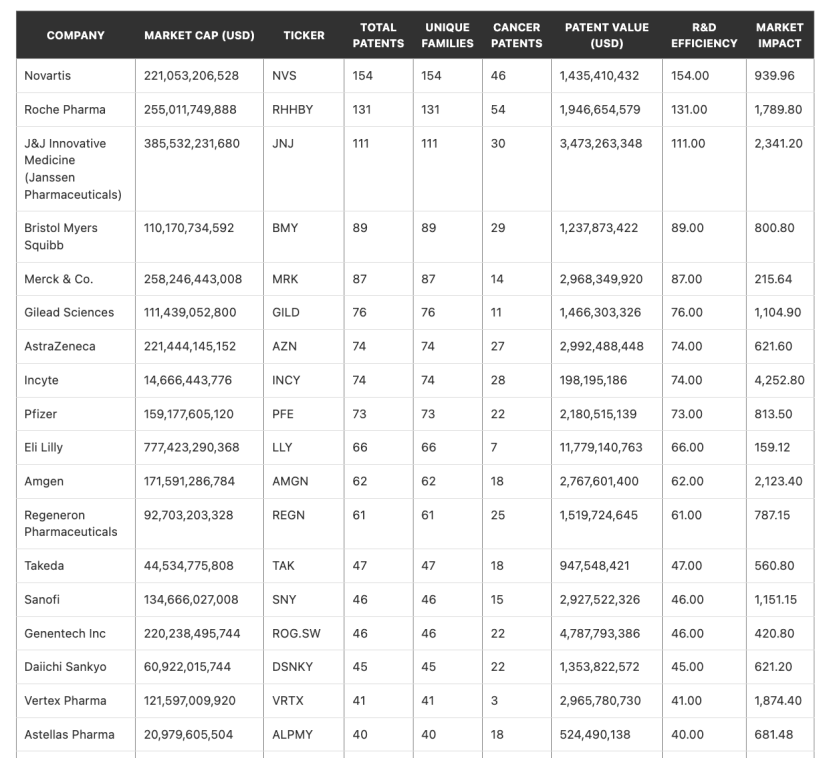
Novartis and Roche enjoy pharma-industry leading 2024 revenues. They also lead in total international patent volume. But Roche, with more oncology-specific patents for cancer treatment has twice the R&D efficiency, an indicator of future growth.
Companies punching above their weight in market impact are often more selective in their use of R&D and efficient in their ability to obtain cancer-related patents, reports Drug Discovery and Development, a leading industry publication. Incyte, with a market cap of $14.7B, achieved the highest market impact score among the top 50 public firms in the dataset, nearly twice that of Johnson & Johnson.
For pharma patents relating to oncology, Roche led the way at 54 international oncology patents in the analysis period, while Novartis had 46 cancer patents in the same time frame. J&J and Regeneron secured 30 and 25 patents, respectively, in the therapeutic area.
While Eli Lilly dominates in market capitalization at $777.4 billion, “its patent value per patent of nearly $11.8B “reflects an outsized market premium.” A substantial portion of its current revenue is a result of the success of the metabolic therapies Mounjaro and Zepbound used to target tumors, which together generated $4.3 billion in combined Q2 2024 revenue.”
Lily was last among the top ten in R&D efficiency, as tracked by DD&D

Universities are vital to drug discovery
Beyond public companies, the University of California system led with 81 pharma-related patents. The group of universities, which includes UC Berkeley, UCLA, UCSF and others, was especially strong in gene therapy and antibody development with six patents in each area. Johns Hopkins University was up next with 34 pharma patents, while Harvard, despite fewer patents (23), had one of the highest citation impacts among academic institutions at 77.52 citations per patent.
Types of Cancer Patents
New drug compounds (e.g., TDO-2 inhibitors, mTOR inhibitors, synthetic retinoids, cannabinoids), targeted therapies, immunotherapies, and vaccines.
-
Diagnostics & Biomarkers:
Methods using lncRNA, DNA mutations (like B-RAF), or molecular lymphatic mapping for early detection and prognosis.
-
Technologies:
AI for imaging/diagnosis, mass spectrometry for protein analysis, ultrasound imaging, and even chlorine dioxide injections for tumor elimination.
-
Delivery Systems:Polymer-drug conjugates and targeting agents to deliver drugs precisely.
Cancer Therapies Dominate
Here too, cancer therapeutics dominated university research, with universities like Duke (just under 30% of its drug patents were in oncology) and Memorial Sloan Kettering (66.67% oncology patents) showing strong focus on cancer treatment. (MSK is a leading oncology-focused hospital and research center.)
Image source: Drug Discovery & Development
 ipcloseup.com