

AI is already making a significant impact on business disputes and legal education. Junior lawyers can no longer be charged out to clients at $500/hr. for simple tasks like checking commas and periods when there are machines to do it for a fraction of the cost.
But rather than lower the cost of patent disputes AI has helped to make litigation more costly. The most experienced partners now charge $1,500 to $2,000 an hour, or more, and they are busier, in part because the low-end tasks are less costly. This is not only true in law, it is in many industries. Demand is greater, so value added human experience that cannot be obtained from AI costs more.
“We have reached the point when engineering students, data scientists, and legal scholars need to collaborate on initiatives examining AI use and regulation,” suggests Wayne Stacy. We are in the process of figuring out when and where “good enough” is acceptable, even if it is not perfect.
The interdisciplinary approach advocated by the Berkeley Center for Law and Technology (BCLT) Executive Director Wayne Stacy, a former former patent litigator and USPTO Silicon Valley Regional Director, addresses a crucial question: how much regulation does emerging technology require?
“Zero is not the answer, and 100% is not the answer, either,” says Stacy.”
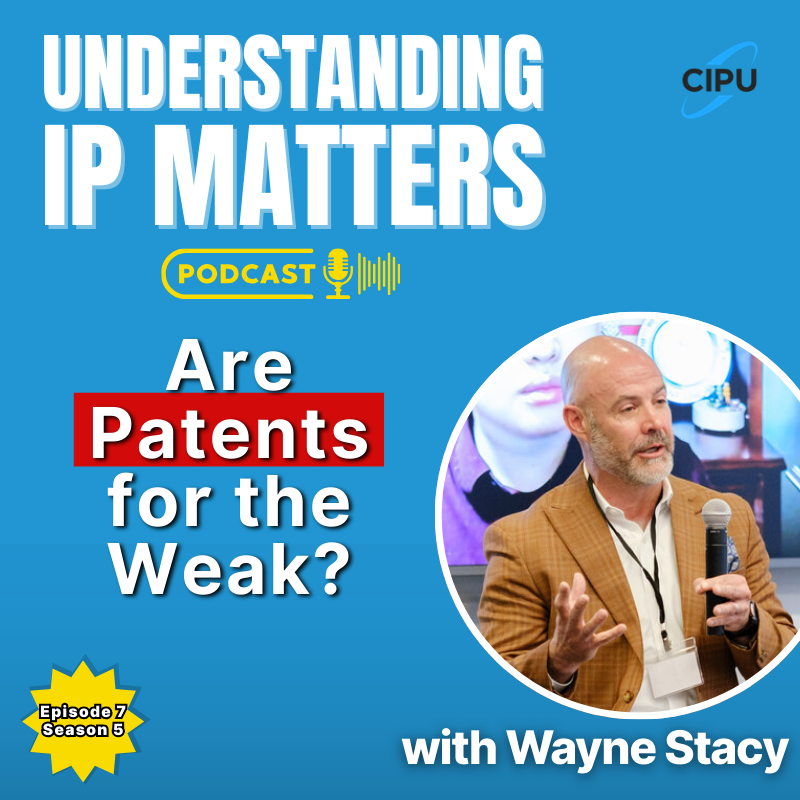
Wayne Stacy is my guest on Ep7 of Understanding IP Matters, the popular podcast the engages with innovation leaders, now on both audio and video. The episode is in part a response to Elon Musk epiphany about certain IP rights: “Are Patents for the Weak?” In fact, explains Stacy, historically they have been more important to many smaller, less capitalized companies that rely on the exclusivity of their rights to level the playing field and attract investors. Unfortunately, that is no longer working as it had.
“The challenge lies in ensuring entry-level lawyers develop skills that complement rather than compete with AI capabilities.”
Businesses like large technology companies own significant market share, brand recognition and have access to large amounts of capital. They often have many patents but do not rely on them in the same way as smaller, “weaker” businesses to generate revenue.
Tap here for the audio, “Are Patents for the Weak?”
Go here for the video.
Greater Volume
Stacy’s perspective on technology’s role in legal practice challenges conventional assumptions. Despite decades of technological advancement—from networked computers to Westlaw and Lexis/Nexis research platforms—litigation costs have not decreased. Instead, technology has enabled more robust legal work and higher document volumes.
This transformation redefines leverage in legal practice. An insurance defense partner who previously managed 20 cases might now handle 100, with AI handling routine briefings and reports. The challenge lies in ensuring entry-level lawyers develop skills that complement rather than compete with AI capabilities.
“The educational model emphasizes scaling up early capabilities. Instead of avoiding AI, students learn to leverage it effectively, understanding both its potential and limitations.”
Preparing lawyers for an AI future is not easy, but it has to be done with open eyes. Rather than teaching students to fear AI hallucinations, Berkeley’s approach focuses on integration.
“What we’re trying to teach is how to incorporate AI so they can have their own mentor from day one,” Stacy explains. This philosophy acknowledges that AI doesn’t need perfection—it just needs to perform at the level of a decent third-year lawyer.
The educational model emphasizes scaling up early capabilities. Instead of avoiding AI, students learn to leverage it effectively, understanding both its potential and limitations. This approach prepares graduates for a legal landscape where human lawyers focus on higher-value strategic work while AI handles routine tasks.
As technology continues reshaping innovation and legal practice, Wayne Stacy’s insights offer a roadmap for educators, practitioners, and policymakers navigating these transitions.
“The key lies not in predicting specific future developments or potential regulations, but in building frameworks for thoughtful adaptation and continued learning.”
Image source: Center for IP Understanding
 ipcloseup.com