
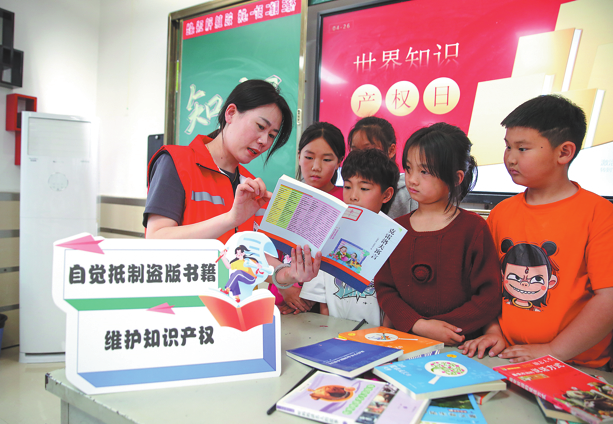
China wants other nations to know it not only has secured many patents and trademarks, it is intent on educating children as young as primary school about the role IP rights play in innovation and brand building, as well as about the critical importance of IP to national economic success.
During a national IP education training program held by the China National Intellectual Property Administration (CNIPA), Dang Jiwu, deputy principal of Xining No 2 Middle School in Qinghai province, said that “the school has abandoned the traditional method of ‘instilling theories’ and instead incorporated IP elements into every subject and aspect of teaching, so that students will naturally develop an IP awareness.”
“China has seen remarkable progress in IP education at primary and middle schools, with an increasing awareness and a growing diversity in education content”
Faculty members have developed a school-based curriculum for students with different needs. “For junior middle school students, we concentrate on raising their awareness of what intellectual property is, enabling them to grasp basic IP concepts through educational activities,” he Dang Jiwu said.
The report of IP awareness activities comes by way of a China Daily story published in December. China Daily is an English-language daily newspaper owned by the Central Propaganda Department of the Chinese Communist Party.
Ramped Up Efforts
While there is likely an element of government encouragement for such IP reports, it is clear that China has ramped up its efforts to educate students about intellectual property and its role in China’s economic success. The goal appears to be recognition for invention, creative expression and recognition of brand value not only for creators and businesses, but for the population in general. Respect for IP rights as potentially monetizable State resources appears to be a goal.
A recent WIPO Pulse Report, “The global IP perception survey,” indicates that positive IP attitudes are ascendant in China and Asia, while they are declining in the U.S. and Western Europe.
The middle school in Qinghai province has established a practical platform, involving societies, competitions and workshops. Its facilities include an electronic maker workshop and Lego robotics laboratory. These spaces are equipped with patent search database terminals, three-dimensional printers and laser-cutting machines, providing hardware support for student innovation.
Fashion Technology
Xining is a high-altitude city in the Qinghai-Xizang Plateau, where physical activity can be challenging due to lower oxygen levels. The student Song Yunyan developed a school uniform, which can supply oxygen through a miniature bio-enzyme oxygen generator embedded in the collar.
He emphasized IP education must be grounded in three pillars: the school’s characteristics,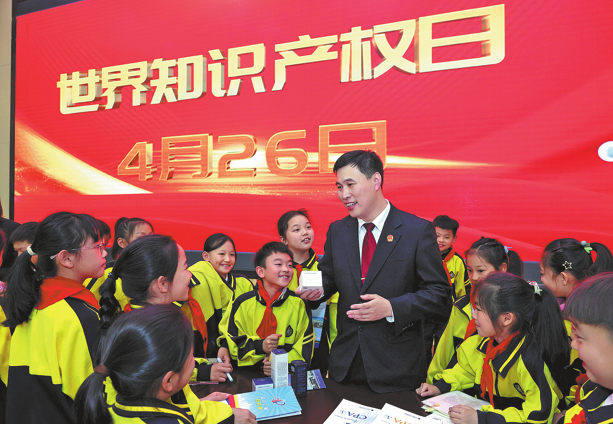 regional conditions and an open ecosystem.
“We need to break the barriers between campus and society, enabling IP education to move beyond ‘small classrooms’ and connect with ‘a bigger stage’, and in this way, it can take root, thrive and bear fruit,” Dang said.
“China has seen remarkable progress in IP education at primary and middle schools, with an increasing awareness and a growing diversity in education content,” a CNIPA official said at the training.
“We need to break the barriers between campus and society, enabling IP education to move beyond ‘small classrooms’ and connect with ‘a bigger stage’, and in this way, it can take root, thrive and bear fruit”
Over the past three years, more than 17,000 full-time and part-time IP teachers in primary and secondary schools have received training, according to CNIPA.
An Asian-Watcher’s Perspective
“Every time I visit [Asia], I feel a pang of envy for societies that seem to value education more than America does,” says Nicholas Kristof, multiple Pulitzer Prize winner who has been reporting on Asia for the New York Times since 1984.
“We Americans eagerly invest in our own children’s education,” continues Kristoff, “but we’re less enthusiastic about paying to educate other people’s kids. In Taiwan, by contrast, the constitution stipulated for decades that education, culture and science must account for at least 15 percent of the national budget; a law that updated it mandates that at least 22.5 percent of combined net budget revenues for government at all levels go to education.
In the United States, education has accounted for a bit more than 2 percent of recent federal budgets.
“… maybe we could manage a bit less complacency about educational mediocrity?,” says Kristof. “Maybe we could acknowledge the inequity of local school finance that results in sending rich kids to good schools and poor kids to weak schools?… What if we respected human capital as much as financial capital?”
Lego Supports IP Education in China
Among the most representative companies helping in China with IP education is the Danish toy giant Lego. Since 2019, the company has provided IP lectures and workshops for more than 1,300 students and 600 residents in over 10 Chinese cities, in collaboration with the newspaper China Intellectual Property News.
“Protecting trademarks is not just about protecting consumer rights but the innovation capacity of the society,” aid Robin Smith, vice-president and general counsel for China and the Asia-Pacific region of Lego Group.
“Through activities close to consumers’ daily lives, we hope to support the publicity and education of IP protection, contributing our efforts to a more favorable environment for innovation.”
For the full story in China Daily, tap here.
Image source: chinadaily.com
 ipcloseup.com