

A few research institutions, such as Stanford, Columbia, NYU and MIT, consider securing invention rights a routine part of their research mission. Most, however, struggle with that role, preferring to share developments through academic publishing, which can undermine their ability to secure patents.
Getting universities on board about IP rights like copyrights and trademarks, as well as patents, can be a challenging cultural shift that requires dismantling deeply rooted misconceptions about what patents and other IP rights represent and how they function in business and society.
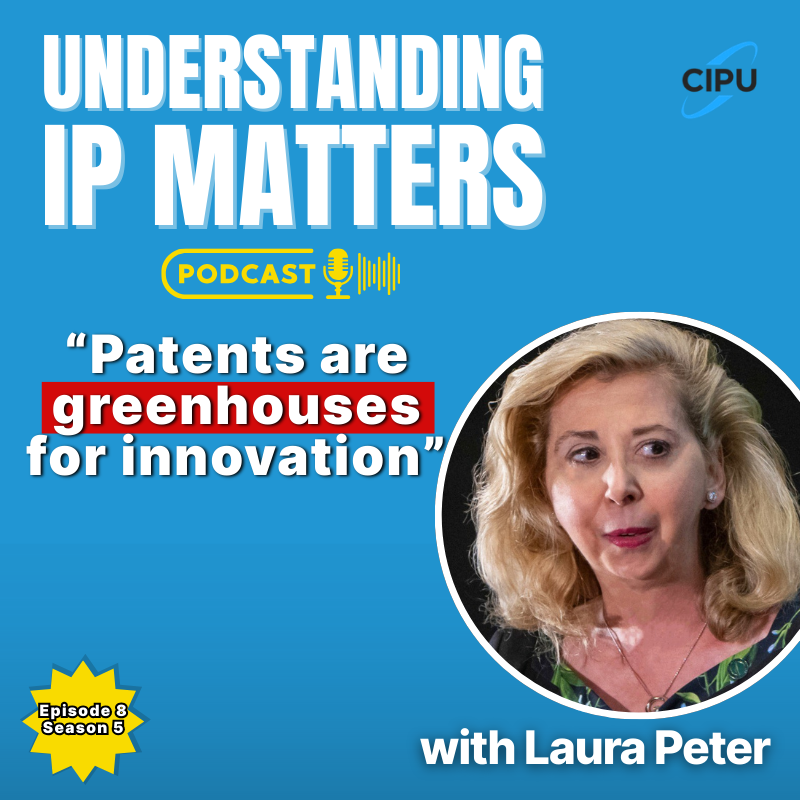
Laura Peter, my guest on episode 8 of this season’s Understanding IP Matters, speaks about the challenges university researchers face coming to terms with their role in innovation and commercialization. Former USPTO Deputy Director under Andre Iancu, Peter provides keen insight into both the the role of patents and their broad benefits.
Transforming How Patents are Seen
Now serving as Executive Director of Research at UNC Charlotte, she is working to transform how universities approach innovation, commercialization and patent rights by applying efficiency and disrupting some of the academic norms that no longer apply to a fast-paced, highly digital, AI-infused research environment.
Laura Peter, my guest on episode 8 of this season’s Understanding IP Matters, speaks about the the challenges university researchers face coming to terms with their role in innovation and commercialization.
To view the audio podcast, tap here.
For the video on YouTube, access this link.
“One of the most frequent impediments I encounter is researchers’ belief that intellectual property means patents, and that patents can impede progress.
“…Patents represent just one vehicle for assetizing and commercializing innovation, and understanding the full spectrum of options enables more strategic decision-making. That IP encompasses a broader range of relevant protections, including copyrights, trademarks, and trade secrets is often overlooked.”
Another common belief Peter addresses is that patents somehow lock away knowledge from the public. At least some of these misconceptions are perpetuated by those businesses who believe they can benefit from them.
“Patents publish 18 months after filing, regardless of whether they ultimately issue. Publication serves an educational function, allowing others in the field to understand the state of technology and potentially build upon disclosed innovations even before the patent term expires. The Founding Fathers understood this balance; temporary exclusivity incentivizes innovation while ensuring eventual public access.”
A Protected Space
“…Just as a greenhouse provides temporary protection for plants to grow before they’re ready for the open environment,” she continues, “patents give innovators protected space to develop their ideas, build products, and establish licensing relationships.
“After that period of limited exclusivity expires, the innovation becomes available to everyone—strengthening rather than weakening the foundation of public knowledge.”
This perspective helps researchers see patents not as antithetical to open science, but as complementary.
“Patents give innovators protected space to develop their ideas, build products, and establish licensing relationships.”
Researchers tend toward perfectionism, wanting to fully develop an invention before seeking protection, Peter states. But provisional filings don’t require perfection—they simply need to clearly articulate the core innovation, establishing a priority date while researchers continue refining their work.
Publish [Patents] or Perish
Laura Peter says it is important to educate university leadership about elevating patent filings to the same status as publication for tenure consideration. While publications demonstrate scholarly contribution, patents represent the additional step of assetizing research for potential commercialization—a process that requires more time and effort than publishing alone.
Peter believes that pending legislation addressing subject matter eligibility could help restore confidence in patent protection for emerging technologies. Clear rules about what qualifies for patent protection would reduce uncertainty and potentially reverse the drift toward trade secrecy.
Are the vast majority of patents not associated with direct revenue worthless? Peter begs to differ:
“While licensing represents an important commercialization path, patents serve multiple business functions. They strengthen marketing efforts—entrepreneurs routinely highlight their patent portfolios when pitching to venture capitalists. Patents signal innovation capacity and competitive positioning…
“They establish credibility and can open doors to partnerships and collaborations.”
Image source: CIPU
 ipcloseup.com