

Vietnam’s new IP law makes business capital easier to obtain by allowing the use of intellectual property assets as collateral.
This is a bold move for any country, let alone an emerging economy that is technically a communist state, governed by a single party that a few decades ago was mired in poverty.
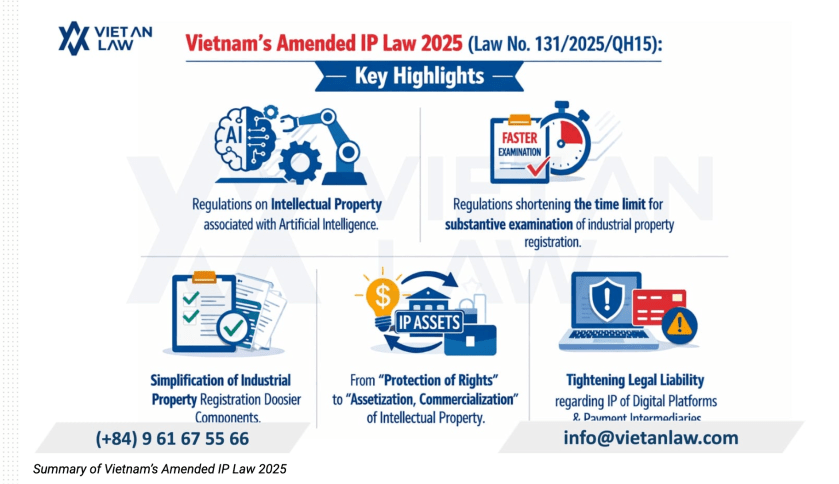
This legislation, which takes effect on April 1, 2026, officially recognizes IP rights – such as trademarks, patents, and copyrights – as commercial assets that can be valued, traded, and used to secure loans.
“Intellectual property must become an asset of enterprises that can be valued, traded, included in financial statements [my bold face], and used as collateral for loans or capital contributions,” wrote Vietnamnet Global, “especially for new technology assets, digital technology, and AI.”
Important Shift
This marks an important shift from a mindset focused mainly on rights protection to one of commercialization and monetization. Intellectual property becomes a strategic competitive tool for enterprises and the nation, reported the publication.
“A developed country is one in which intangible assets and intellectual property account for a large proportion of total national assets,” reported Vietnamnet Global.
With the new IP law the time limit for content appraisal of patents has been shortened from 18 months to 12 months and a mechanism for accelerated appraisal within three months is added. This demonstrate a s”trong reform step.”
“Intellectual property must become an asset of enterprises that can be valued, traded, included in financial statements, and used as collateral for loans or capital contributions.”
The amended IP law officially classifies intellectual property as a “bankable asset” and “property right,” making it a recognized form of collateral for financing. For all of the optimism of the new law, Vietnamese businesses with need to come up with patents, copyright, trademarks and trade secrets that have bankable value, if not revenue streams associated with them. No small feet, even in Western economies.
The state actively encourages businesses, especially Small and Medium Enterprises (SMEs) and tech firms, to leverage their intangible assets (brands, technology) for capital, moving away from a purely tangible-based collateral model.
Creditors who provide loans have the right to exploit or auction the IP assets in the event of default.
- Benefits. Provides a new source of financing for “asset-light but idea-rich” companies, encouraging innovation and the development of intangible assets.
- Challenges: The valuation of IP remains a “bottleneck” due to a lack of uniform standards. Furthermore, the secondary market for selling distressed IP assets is not yet fully mature.
Enterprises will be required to record IP assets in their financial statements, strengthening their balance sheets for lenders.
AI Treatment
The law affirms that AI-generated products are not a subject of intellectual property rights. In cases where products are automatically generated by AI without human involvement, they are not eligible for copyright or patent protection like works created by humans.
For products created by AI, the law affirms that AI is not a subject of IP rights. If a product is automatically generated by AI without human participation, it is not eligible for copyright or patent protection as a work created by a human.
With regard to raising awareness and enhancing enforcement, the IP law states there is a requirement to raise social and corporate awareness of IP as a fundamental solution.
If a human uses AI as a tool to create a product and makes a significant creative contribution (idea, direction, selection, editing of AI results, etc.), they may be recognized as the author or inventor.
IP Awareness is Written Into Law
With regard to raising awareness and enhancing enforcement, the law states there is a requirement to raise social and corporate awareness of IP as a fundamental solution. “Intellectual property will be incorporated into general and higher education, while communication and outreach to enterprises and communities will be strengthened.”
The meaning of incorporation into general and higher education was not specified.
It remains to be seen, however, how reliable the business-generated rights are; how accurately they will be valued and recorded; and if they will be sufficiently liquid to create a true market.
The new Vietnamese IP laws are heartening, especially for a small nation still developing from recent poverty. It remains to be seen, however, how reliable the business-generated rights are; how accurately they will be valued and recorded; and if they will be sufficiently liquid to create a true market.
In 2024, the People’s Court of Hanoi issued its first criminal sentence for online copyright infringement. The court said it did so to emphasize its political commitment to safeguarding the rights and interests of IP owners equally alongside public rights.
Image source: vietanlaw.com; vietnamip.com
 ipcloseup.com