

After closing its latest round of funding on October 2nd, OpenAI, the company behind ChatGPT, is now valued at an incredible $157 billion.
This might look great on paper, but it means that justifying market value for a businesses like ChatGPT and investors like Microsoft, is going to require extraordinary if not unprecedented performance over the next three years.
OpenAI expects to lose $5 billion this year. It is becoming clearer that largest LLMs may not be the ideal business model, or the only one.
The recent financing netted it $6.6 billion in new funding for OpenAI. This valuation puts the company on par with the market caps of publicly traded companies like Goldman Sachs and Uber.
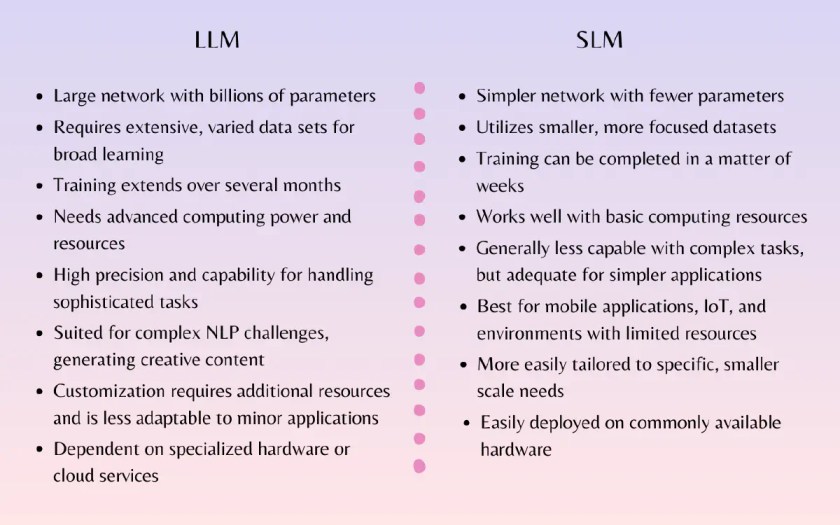
The complex economics of generative AI LLMs – including training costs, data centers and costly Nvidia processors – is driving interest in smaller, more focused and less costly AI models that provide businesses the data they need to succeed in specific tasks. These SLMs (Small Learning Models) do not attempt to achieve a “one-size fits all” solution.
Small(er) Learning Models
“Small models are typically deployed for a single specific task”, reports Salesforce. “They’re far less expensive, more efficient, higher performing and, often, more accurate than LLMs.”
Small models are typically deployed for jobs such as answering customer questions about a certain product, summarizing sales calls, or drafting marketing emails. They can be more computationally efficient and faster than LLMs due to their small size and higher-quality, more targeted data.
Open-Source Alternatives
Both Meta and Google are promoting open source AI models, which will have a different business strategy. No doubt, at some point there will be services that users need to pay for or, more likely, these Internet giants will build returns into the monetizable data that users provide them.
Proponents of open-source software believe that it promotes innovation and collaboration, as developers can build on the work that has been done before them. It also makes it possible to customize and fine-tune existing tools and models for specific or niche applications, reports Forbes.
Unlike closed-source models, developers can “peek inside” open-source models and understand how they work. They may then be able to find opportunities for improving it or adapting it for new tasks and use cases. And the costs are lower.
“In the case of ChatGPT,” The Economic Times, next to the WSJ the most read English language business periodical, “its parent company, OpenAI, releases neither the dataset nor code of its latest AI tools to the public. This makes it impossible for regulators to audit it. And while access to [parts of] the service is free, concerns remain about how users’ data are stored and used for retraining models.”
Open-source models are often championed by promoters of ethical AI, as they can generally be considered more transparent and understandable than closed-source models.
From a business point of view, the advantage of open-source models is that, in theory at least, they are essentially free to use. The fact is there will often be expenses involved with setting them up and getting them to work the way you want them to. They might involve contracting with third-party commercial providers, possibly Meta and Google.
In April 2024, Meta released Llama 3, a large language model touted to be more powerful and diverse than its predecessors.
One way Llama 3 is set apart from other large language models, like Claude, Gemini, and GPT, is that Meta has released the model as open source – which means it is available for research and commercial purposes. However, the license is custom and requires that users adhere to specific regulations to avoid misuse.
Will closed or open source be better for content owners and distributors. That’s difficult to say at this point. OpenAI, Chat GPT’s owner, has begun negotiate with content providers who hold copyrights and seek costly licenses. It is unclear if the open-source AI businesses will follow.
“Apple has apparently paid image, video and music database service Shutterstock to access its vast archive of files,” writes Inc., “all with the goal of taking the files and training AI systems.”
The deal is said to be worth between $25 million and $50 million, according to Reuters. Apple isn’t the first to reach a deal with Shutterstock: Meta, Google and Amazon have apparently already done so.
Shutterstock earned $104 million in 2023 from licensing its image and video catalogs to OpenAI, Meta, and others, Bloomberg reports.
Training Costs
Apple has reportedly been exploring AI deals with Conde Nast, NBC News and People, reports PressGazette, and Daily Beast owner IAC to license their content archives, but nothing has yet been made public.
According to The Verge, OpenAI is reportedly offering news organisations between $1m and $5m per year to license their copyrighted content to train its models – although News Corp’s deal is reportedly worth more than $250m over five years.
Rest assured, the open-source approach to AI for large public or private companies is not charity, or humility. History has shown Google, Meta and others not very respectful of copyright holders’ rights, in particular, and personal data, in general. Controlling or knowing the the most valuable prompts and their output, for example, can transcend the high costs associated associated with training and servicing LLMs.
A partner at the venture-capital firm Sequoia Capital, reports Dow Jones’ WSJ, recently calculated that to justify this year’s investment in data centers and chips alone AI businesses will ultimately need to generate $600 billion in revenue.
OpenAI, the company behind ChatGPT, is projected to generate $2.7 billion in revenue from ChatGPT in 2024. This is an increase from $700 million in 2023. OpenAI also expects to generate $1 billion in revenue from other businesses using its technology. The losses are much higher.
Will Subscriptions be Enough?
$20 per month subscriptions are not a model for success. Do not be surprised if the largest GenAI LLMs pass-on the cost of training or expect a royalty for use of their output or revenue facilitated by it.
Remember, the internet and social media were and still are largely “free” — save for the highly valuable and monetizable personal data individuals, willingly or not, provide many of the companies that resell them.
Image source: https://sanctamaria.in; winder.ai
 ipcloseup.com