

A group representing 2,200 publishers and news outlets have launched a highly organized and uncharacteristically aggressive ad and social media campaign against A.I content theft they say has been perpetrated by some of the largest tech companies.
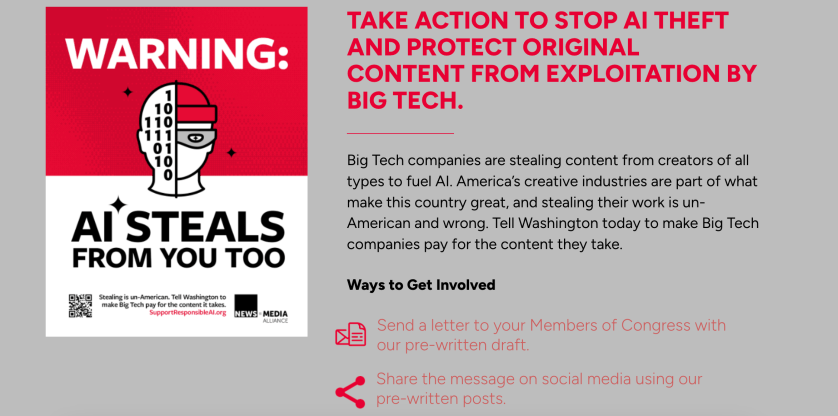
The news outlets and publishers have been running ads urging the federal government to protect copyrighted content from unauthorized use by A.I. platforms. The campaign, “Support Responsible AI,” is run by the News/Media Alliance trade association and consists of several ads that have been appearing in print and online.
The strongly worded campaign pulls no punches about what its members seek to rectify – outright theft of their property from those who should know better.
One ad reads “Keep Watch on AI,” while another states “Warning: AI Steals from You, Too.”
From Copyrights to Patents
It is unclear at this point whether the in-your-face action against copyright abuse by companies, such as Microsoft, Google and Meta, who own or control AI counterparts, will eventually include recognition of predatory patent infringement, considered by many to be theft on a grand scale.
While China remains a threat and easy target, there is arguably more domestic theft of copyrights and patents than foreign.
The ad campaign, which has run in hundreds of news publications and digital outlets across the country, has three key asks:
- Require Big Tech and AI companies to fairly compensate content creators.
- Mandate transparency, sourcing, and attribution in AI-generated content
- Prevent monopolies from engaging in coercive and anti-competitive practices.
Many angry patent owners also have locked horns with Big Tech over IP rights. Owners have found it virtually impossible to license on fair and reasonable terms since the eBay v. MercExchange in 2006, which effectively eliminated injunctions for infringement, and the establishment of the Patent Trial and Appeal Board, part of the America Invents Act in 2011.
Outdated IP legislation, unsympathetic courts and hold out licensees devalue patents and make many transactions impossible, threatening innovation and competition.
Ads in the NMA campaign include phrases like, “Keep Watch On AI,” “Stop AI Theft,” and “AI Steals From You Too,” while the text on the bottom reads: “Stealing is un-American. Tell Washington to make Big Tech pay for the content it takes.”
The campaign comes just weeks after OpenAI and Google wrote letters to the government, urging it to allow their AI models to train on copyrighted content without paying owners or publishers because of foreign competition.
OpenAI, 49% owned by Microsoft (market cap $3.26 trillion), has a current market value of $300 billion, and Google, (market cap $1.86 trillion), are among the wealthiest companies in the world. Their letters cite potential threats from China and businesses like DeepSeek as the primary reason for the need for a free ride. MS’s $13 billion investment in OpenAI is currently worth just under $150 billion.
Inventors and businesses besieged by serial patent infringement over the past 20 years due to the weakening of rights, have shied away from such confrontational tactics as the New/Media Alliance’s. But if the NMA campaign is any indication, IP holders are becoming increasingly fed up with the arrogance of free-riders who can well-afford to pay for the content they use or scrape.
During Covid-19, billboards in Washington, DC and Geneva displayed “Patents Kill!” – and they did not mean they rocked in a positive way. The message was that proprietary invention rights are dangerous because they impede populations from receiving the vaccines or medications they would otherwise be able to provide if it were not for patents.
Dangerous Myth
This ancient myth is dangerous. It fails to grasp the high cost of solutions (typically, in the billions of dollars) and the necessity of return on investment capital for companies that conduct concentrated, potentially commercializable research.
But patent access is only part of the equation. Even if the patents were available to all license free delivering life-saving products based on them is highly unlikely. Specialized knowledge about building plants to manufacture and managing processes protected separately under trade secrets would make it virtually impossible to get vaccines and medicines into the hands of the people who need them in a timely manner.
Patents are published well before they are issued and are public for all to see. They are not secret or a blueprint. They are one part of a very large equation.
If anything, predatory infringement kills. Its impact on innovation quality, speed to market, investor confidence, foreign competition and domestic economy can not be overstated.
Health organizations may be better advised to ask life science businesses that develop life saving vaccines and drugs to make them more widely available to those who can not afford them. Rewarding excellence with obsolescence in not much of an incentive.
Former Deputy Director General of the World Intellectual Property Organization (WIPO), James Pooley, has called government march-in of invention rights under the banner of greater good is a “sugar high.” It would be nice if governments were capable of solving problems on their own with no profit motive. But it has been proven, repeatedly, they can only address parts of the solution. They are not established to fund and manage commercializable products and attract the necessary capital, nor should they. That’s why technology transfer works.
The blatant misrepresentation of centuries of patent benefits, and the conscious attempt to establish a negative IP rights meme, needs a more visceral response. That appears to be what the publishers and news media believe. Opposition to patent exclusivity may include those with good intentions, but it is driven in large part by executives frightened that their business model and share price will suffer from the cost of paying for the invention rights they need. Their response: actively seek to devalue patents and discredit their owners.
If anything, predatory infringement kills. Its impact on innovation quality, speed to market, investor confidence, foreign competition and domestic economy can not be overstated. It is a lot more harmful than it looks.
___________
The News/Media Alliance is a nonprofit organization representing more than 2,200 news, magazine and digital media organizations and their multiplatform businesses in the United States and globally. Alliance members include print and digital publishers of original journalism. The association focuses on ensuring the future of journalism through communication, research and advocacy.
Image source: NewsMediaAlliance
 ipcloseup.com