
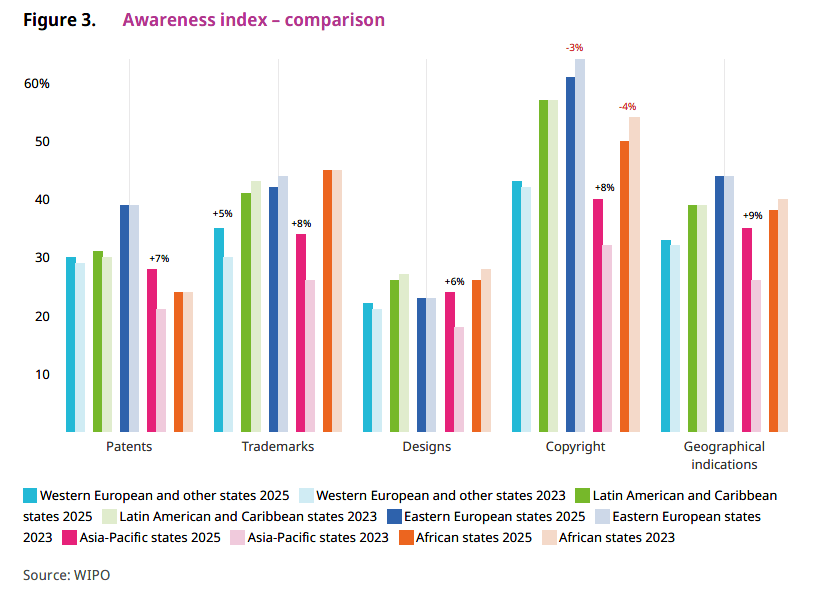
Public IP awareness has grown measurably over the past two years in China and parts of Asia while the U.S. has seen a slight decline.
The World Intellectual Property Organization (WIPO) Pulse Report notes that awareness of patents, trademarks, designs, copyrights and geographical indications has increased globally compared to the previous edition of the survey in 2023. However, this growth is uneven. In some regions, people show rising familiarity with IP rights while in others there is a decline.
“The results reflect a deeper mix of knowledge, uncertainty and developing understanding rather than an overall global trend in one direction,” the survey of 35,500 respondents in 74 nations states.
While the findings are generally positive for IP awareness, especially in parts of the Asia region, large gaps remain in the data collected and interpretation of their impact.
Public perception, concludes the report, affects how intellectual property operates in the marketplace. When people associate protected products with authenticity or clarity of origin, this influences purchasing choices.
“The findings reveal notable progress in global IP awareness alongside persistent regional disparities in all five IP rights (or IPR) namely: Patents, Designs, Trademarks, Copyright and Geographical Indications, reflecting a growing recognition of their importance.”
While the findings are generally positive for IP awareness, especially in parts of the Asia region, and the methodology is shared, gaps remain in explaining the data collected and interpretation of their impact.
Likely Differences
Perception of IP rights is likely to differ from consumers, to creators, to strategic rights owners, believes IP CloseUp. Western patent and copyright owners are more likely aware of IP rights than ever, but less favorably disposed.
It is unclear if this is as a result of increased patent and copyright uncertainty because of legislation, inconsistent rule-of-law, increased licensing difficulty and activities that disparage IP rights on the part of vested interests.
Why are some nations more optimistic than others? What has led them to those perceptions? Do public or consumer perceptions reflect what inventors, creators, IP owners, investors and lawyers believe? Are they more or less optimistic than in the past?
Even if the general population has a more favorable attitude toward IP rights because of perceived value or opportunity, the survey leaves the likely contrasting perceptions of creators and some entrepreneurs unexamined. Comparing and contrasting them would seem quite revealing.
“IP awareness is not necessarily understanding,” said ex-IPO Education Foundation and former IBM Chief Patent Counsel Manny Schecter told IP CloseUp.
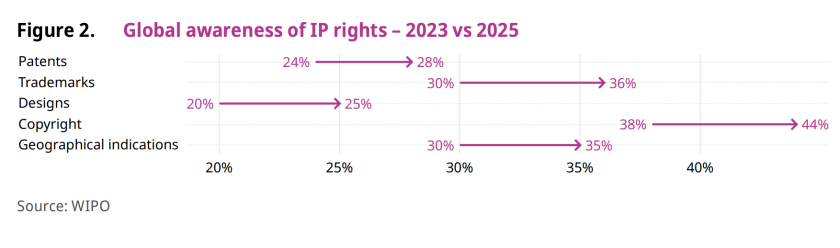
The Pulse Report executive summary provided no percentages. Findings are conveyed in a series of graphs that need to be carefully parsed (see above) in order to understand what they are conveying. The most accessible is figure 2, which indicates that global awareness of copyrights and trademarks grew the most (6%) over 2023, designs and “geographical indications” (5%), and patents the least (4%).
WIPO has long provided important initiatives on behalf of the global understanding of IP rights. Its research has been particularly relevant to the progress of developing nations, which often lack the resources and education to be IP-aware, and the experience to deploy IP rights to the economic advantage.
WIPO’s recent Pulse Report, “Global Intellectual Property Perception Survey 2025,” is an update of its 2023 report and moves the understanding of IP perception a step further. It is may raise more questions than it answers, but it is a solid beginning.
Why are some nations more optimistic than others? What has led them to those perceptions? Do public or consumer perception reflect what inventors, creators, IP owners, investors and lawyers believe? Are they more or less optimistic than in the past?
The 48-page WIPO Pulse Survey analyzed the perceptions of intellectual property of 35,500 respondents in 74 countries that represent approximately 80% of the target population aged 18 to 65 worldwide between February 20 and April 25.
“Based on the report’s findings,” wrote Intelepedia, “public perception affects how intellectual property operates in the marketplace. When people associate protected products with authenticity or clarity of origin, this influences purchasing choices.”
Across all regions, there is strong confidence in the positive economic role of IP rights; meanwhile, perceptions of negative impacts have decreased, particularly in Western European and Asia-Pacific states.
Saudi Arabia ranked among the top performers in awareness and the role of intellectual property in supporting the economy. National awareness of IP’s impact on economic growth and innovation reached approximately 80%, placing the Kingdom at the top of this global indicator, according to SPA, the official Saudi press agency.
“This advanced performance reflects the efforts of the Saudi Authority for Intellectual Property to enhance public awareness of and respect for intellectual property rights,” said SPA in a statement, “as well as to expand national initiatives aimed at improving compliance and reducing violations.
“These measures have helped strengthen consumer confidence in original products and underscore the societal value of intellectual property rights.”
IP Confidence Declined in Western Europe
Confidence in the advantages of IP rights remains high, globally, despite a noticeable decline in Western European and other states. Consumers in the Asia-Pacific states present the highest level of belief in the economic benefits of IP rights.
While overall confidence persists, however, certain countries, such as Japan, Singapore, and the Republic of Korea, reported lower levels of agreement.
The report also revealed that “consumers across all five regions predominantly perceive the greatest benefits from innovations in ‘Digital Communication,’ followed by ‘Food and Nutrition,’ ‘Household Appliances,’ and ‘Computer Technology.’”
In Western European countries and other states, consumers report a decline in the perceived benefits of innovation in all measured sectors, a trend driven in part by consumers in the United States.
If education is facilitating positive IP awareness in China, Asia and parts of the Mid East, is the lack of learning in school or elsewhere negatively impacting Western Europe and the U.S.? What does Asia’s IP education and content include the the West does not?
Key IP perception findings:
- Global awareness of all five main IP rights (patents, trademarks, designs, copyright, and geographical indications) has increased.
- Awareness grew the most for trademarks and copyright, which rose from 30% to 36% and 38% to 44% respectively between 2023 and 2025.Regional variations persist:
- Asia-Pacific: Shows substantial progress in IP awareness for both youth and women across all IP rights.
- Western Europe and other states: Show increased awareness among youth.
- Eastern Europe: Experiences a decline in awareness among youth.
- Latin America and Caribbean: Shows mixed results, with youth patent and trademark awareness declining.
- Africa: Awareness decreased for youth and women, particularly for designs and copyright.The WIPO Pulse 2025 survey is the second edition of the global survey, with 35,500 interviews conducted across 74 countries to create an “Awareness Index” that combines self-reported knowledge with objective tests.
If education is facilitating positive IP awareness in China, Asia and parts of the Mid East, is the lack of learning in school or elsewhere negatively impacting Western Europe and the U.S.? What does Asia’s IP education and content include the the West does not?
What WIPO says the survey results mean:
- A positive trend in public understanding of IP, which is crucial for fostering creativity and economic growth.
-
The need for targeted educational and outreach efforts in regions where awareness is declining or lagging.
Go here to access the full report.
Image source: WIPO Pulse 2025
 ipcloseup.com