
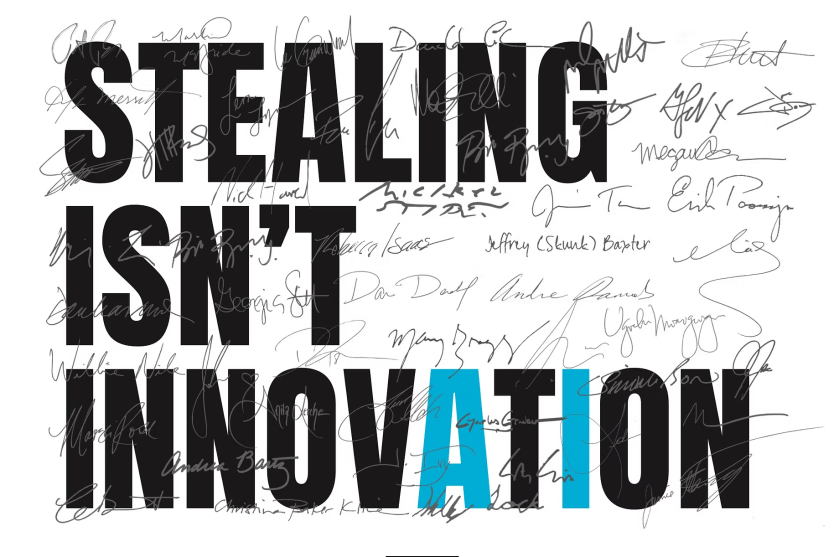
More than 700 creators have signed a proclamation denouncing unauthorized use of news, movie, recording, photography and other content by AI models as stealing.
The broad range of content industry workers are participating in an unprecedented campaign that advocates for more licensing agreements and less theft.
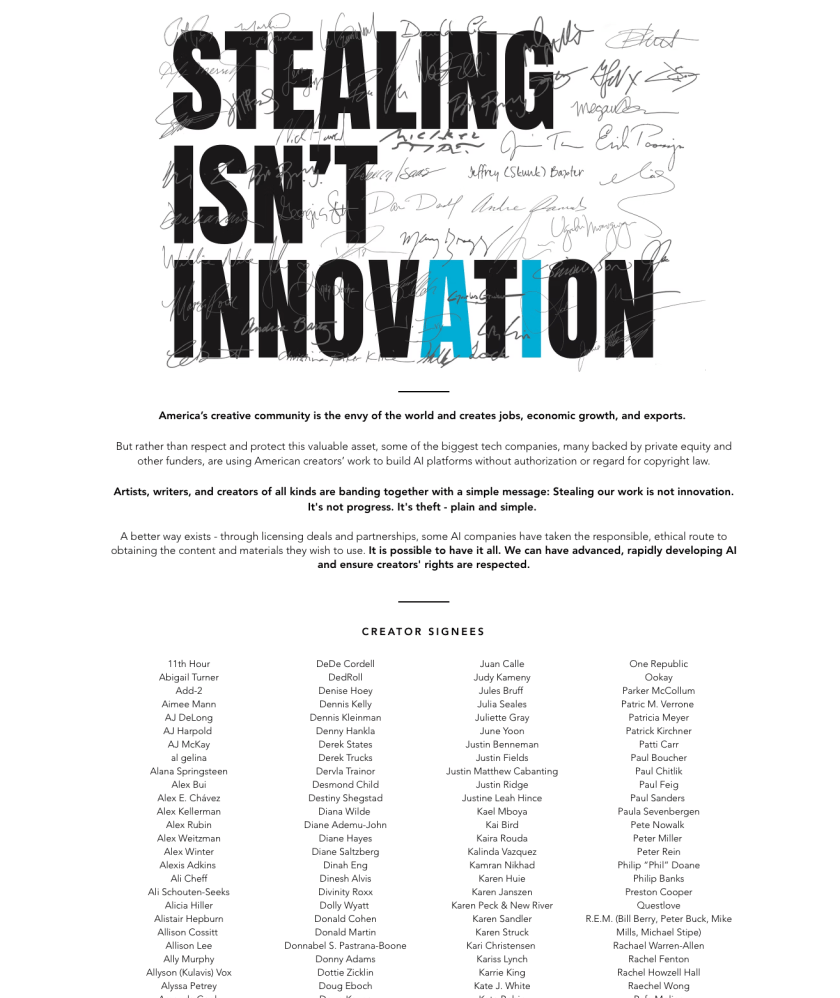
In a series of ads that began running on p.1 of The New York Times on January 22nd and have been running periodically since, the headline reads “Stealing is Not Innovation.” The signed statement says that AI companies should not be permitted to train their models on human-created content without licensing agreements.
Among the signers are SAG-AFTRA, The News Guild and the NFL Players Association, as well as many celebrities, including Jennifer Hudson, Cate Blanchett, LeAnn Rimes, Jodi Picoult, Bonnie Raitt and Scarlett Johansson.
Kudos to the organizations, guilds, celebs and working creators who have stepped up to make clear to the public the danger not only to their careers, but to businesses and content quality.
I wonder if patent holders have the vision to similarly call out predatory infringers in so bold and strategic a manner?
Not there for the taking
As abundant and accessible as content is today, it is not there for the taking. Never has that message been more succinctly stated than in a current advertising campaign on behalf of creators that has been actively supported by The Times. (Full disclosure: The Times is engaged in litigation with AI aggregators, including OpenAI, Microsoft, and Perplexity.)
The lead and successive advertisements throughout edition led with the image, “Stealing Isn’t Innovation.” It seems simple enough, but startling few people act like they agree.
The message is clear, concise, and visual, so that readers of mainstream media could not miss or misunderstand it, even if they do not click through and read the statement of seven core principles.
Somebody finally got the message about the IP message.
Kudos to the organizations, guilds, celebs and working creators who have stepped up to make clear to the public the danger not only to their careers, but to businesses and content quality.
The ad was placed by the Human Artistry Campaign. It is obviously more focused on creative industry workers and content than inventions and inventors. However, its point is relevant to all innovators today: As easy as it is to steal and generate fake or altered digital content, it is even easier with AI and can never be acceptable.
“Today, we are supporting a public awareness campaign, along with creators across many industries, to fight the systematic theft of our work by A.I. companies,” said New York Times publisher A.G. Sulzberger. It is not clear how much of the space cost The Times covered.
Not victimless
Innovation theft is not a victimless crime. It’s dangerous not only to copyright holding creators and patent protected inventors, but to businesses and society, and discourages investment.
The Human Artistry Campaign ads continue have continued to run atop and throughout the other editions of The Times’ front page and throughout. It is not clear for how long or where else. Pretty bold, I would say, especially for mainstream media. Will infringed patent holders as a group resort to similar;y strong messaging in the face of continued propaganda calling licensors “trolls” and billboards in Washington and Geneva stating that patents “kill.”
To see the ad:
The text:
“America’s creative community is the envy of the world and creates jobs, economic growth, and exports.
“But rather than respect and protect this valuable asset, some of the biggest tech companies, many backed by private equity and other funders, are using American creators’ work to build AI platforms without authorization or regard for copyright law.
I wonder if patent holders have the vision to similarly call out predatory infringers in so bold and strategic a manner?
“Artists, writers, and creators of all kinds are banding together with a simple message: Stealing our work is not innovation. It’s not progress. It’s theft – plain and simple.
“A better way exists – through licensing deals and partnerships, some AI companies have taken the responsible, ethical route to obtaining the content and materials they wish to use. It is possible to have it all. We can have advanced, rapidly developing AI and ensure creators’ rights are respected.”
Core Principles
The Human Artistry Campaign’s seven core principles for artificial intelligence applications in support of human creativity and accomplishment:
- Technology has long empowered human expression, and AI will be no different
- Human created works will continue to play an essential role in our lives
- Use of copyrighted works, and the use of voices and likenesses of professional performers, requires authorization and free-market licensing from all rightsholders
- Governments should not create new copyright or other IP exemptions that allow AI developers to exploit creators without permission or compensation
- Copyright should only protect the unique value of human intellectual creativity=
- Trustworthiness and transparency are essential to the success of AI and protection of creators
- Creators’ interests must be represented in policymaking
A call for transparency
This pro-innovation and IP rights ad is a call for transparency. AI has gathered and made available massive amounts of content, and in some cases inventions. On the surface that seems ok. But it also means someone, not just celebrities, is not being paid for their output. For many, it is lost revenue they might otherwise need to live and work.
Innovation often feels like it is there for the taking, or should be. But whether or not LLM’s or users like it, rule-of-law applies to property, all property. Intellectual property rights typically belong to someone or something. The technology exists to track ownership and respect these rights, but most content content aggregators would prefer not to pay if they do not have to.
Businesses that control and individuals that use GenAI may want to believe everything digital is available under a broad interpretation of fair use. They are only fooling themselves.
Image source: Human Artistry Campaign
 ipcloseup.com