

Media coverage of patented inventions, brands and copyrighted content, like movies and music, never strong, has grown progressively weaker with the ascendance of AI and less certain IP rights.
Are journalists under educated, misinformed or simply playing to stereotype, or does the mainstream business and tech media informed by their powerful supporters? Three of the top IP podcasters weigh in on the current episode of “Understanding IP Matters,” out today.
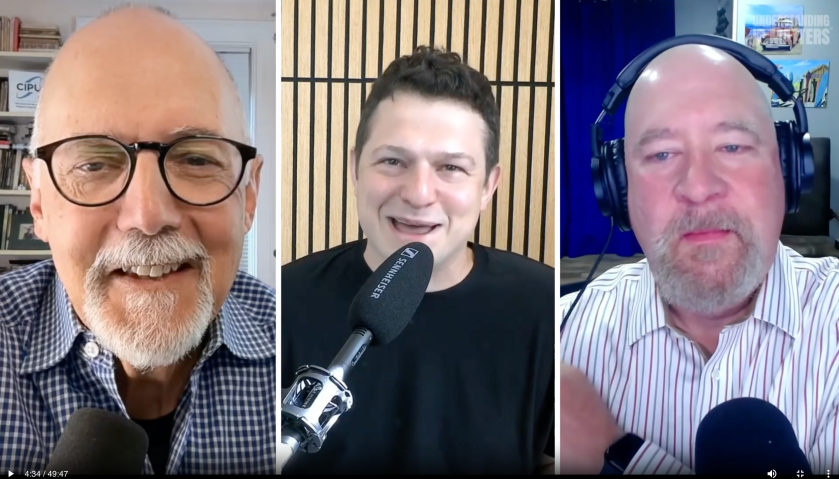
Feedspot lists 761 IP podcasts. Three of the top are hosted by the inimitable Gene Quinn, publisher of IPWatchdog, the leading IP daily; Eli Mazour, an IP attorney who likes to talk and ask questions; and me, Bruce Berman, an IP communications veteran who works with inventors, law firms and businesses.
Quinn, Mazour and I spend our careers trying to make patents and copyrights make sense both to people who are not lawyers and including policymakers. In this conversation they speak candidly about why that job keeps getting harder.
Quinn does not hedge when I ask where patent and copyright protections stand today:
“I would say IP rights are really at the bottom of what they have been during my lifetime,” he explains, describing the effort to defend intellectual property as “shoveling water back into the ocean.” The highest profile, biggest money disputes tend to generate the media coverage. More relevant IP developments, like dangerous legislation and abusive behavior, are considered by most reporters too abstract for their sophisticated audiences and are seldom covered, let alone accurately.
To listen to or watch the episode, “Top 3 IP Podcasters Speak Out” go:
Audio – https://www.buzzsprout.com/1537696
Video – https://www.youtube.com/channel/UCZk165UL2V8fNiJjVcQtnmQ
AI has Fueled IP Uncertainty
On the copyright side, Quinn points to the uncertainty created by generative AI: “If a company can train a model on a writer’s or artist’s entire body of work, call it ‘fair use,’ and the creator gets nothing in return, there are no rights to be had.” Copyright does not exist. On the patent side, Quinn says damages have shrunk even when infringement is proven, and the Federal Circuit has made it difficult for patent owners to see real value from a win.
Mazour, who describes himself as more naturally optimistic, points to a few hopeful signs: improvements at the USPTO and in post grant proceedings, and a wave of licensing deals between generative AI companies and major entertainment and media companies.
Mazour notes that some of these AI companies could likely have afforded to litigate indefinitely, and chose to settle and take a license instead, which suggests copyright holders have more leverage than it might appear. Berman adds that even large settlements, like Anthropic’s reported 1.5 billion dollar deal, are increasingly viewed as a bargain compared to prolonged litigation.
Exclusive rights that block competitors from copying an invention actually produce more innovation, not less, notes Quinn, because competitors are forced to invent around the blockage rather than simply copy it.
Copying is Not Creating
“If patents are weak, all you can do is copy me and then we’re static, it doesn’t grow,” Quinn says. The logic holds up, he argues, but it runs against people’s first instinct, which makes it a genuinely hard story to tell. Quinn also points out a frequent contradiction among large technology companies: executives who hold tens of thousands of patents themselves still argue against strong patent rights when those rights are used against them. “They like their patents; they don’t like other peoples’.”
“If a company can train a model on a writer’s or artist’s entire body of work, call it fair use, and the creator gets nothing in return, there are no rights to be had.”
There is little financial incentive in covering IP news closely, explains Quinn. By the time a publication gets around to writing about a development, the relevant agency has often already issued a press release, and the story has already circulated and there is little that can be added.
Mazour adds that even when outlets do cover a major verdict, they frequently omit that a large share of big jury awards get reduced or thrown out on appeal, leaving readers with an inflated and often permanent impression of the case’s outcome.
I raised the recurring villain of press coverage: the pharmaceutical company. Quinn pushes back on the caricature. He points to the common experience of picking up a prescription that costs only a few dollars for a full course of treatment, something made possible because the drug went off patent and became a generic, after the original patent holder recouped its investment. “Somebody paid it forward,” he says.
IP Education?
I asked what IP education should look like, starting with law schools and business schools, and how much lawyers, engineers, and executives actually need to know. Quinn argues the gap starts much earlier than graduate school. He describes encountering engineers who tell him that helping write a patent application is not their job. Quinn disagrees sharply.
“It’s precisely their job,” he argues. If an engineer invents something that becomes a company asset, securing that asset through the patent process is part of their work, not separate from it. “People are never taught what these assets are for, so they never learn to value them.”
Go here to access episodes of IPWatchdog Unleashed, Clause 8 and Understanding IP Matters.
For audio of the current episode, go here; for video, here.
Image source: Center for IP Understanding

