
26 of a tiny company’s 31 finger print scanning patents were recently transferred to Apple. How Apple plans to use the invention rights is not

26 of a tiny company’s 31 finger print scanning patents were recently transferred to Apple. How Apple plans to use the invention rights is not
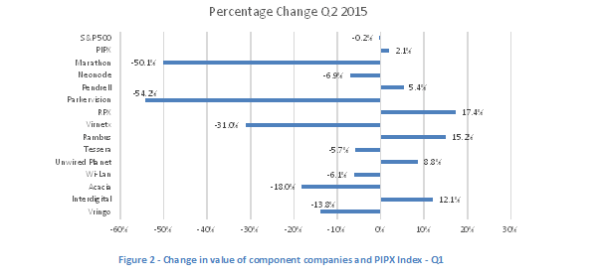
The PIPX Index of 14 of the larger publicly held patent licensing companies rose by 2.1% for the second quarter 2015, beating the S&P 500

Shares of public IP companies (PIPCOs) continued to fare poorly in the 2Q of 2015. The stock of companies with larger market capitalization tended to

Companies that own intellectual property rights typically generate 29% higher revenue per employee, have about six times as many employees, and pay wages that are
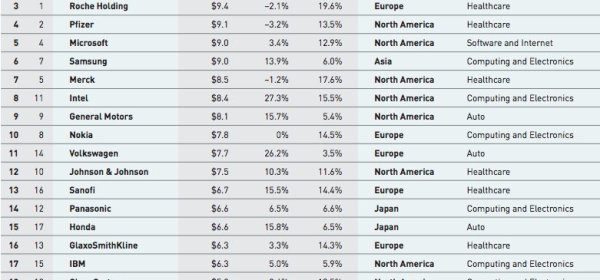
Which companies are truly (disruptively) innovative and which are merely using their R&D to maintain a low-growth franchise has become the subject of worthy debate.
Three things are needed to succeed today in patent licensing: more capital, more patience and more good patents, which are in increasingly short supply. Uncertainty

With patent litigation down 13% over 2013, and median damages awards just $2.9 million, the lowest in at least 20 years, NPEs are still besting
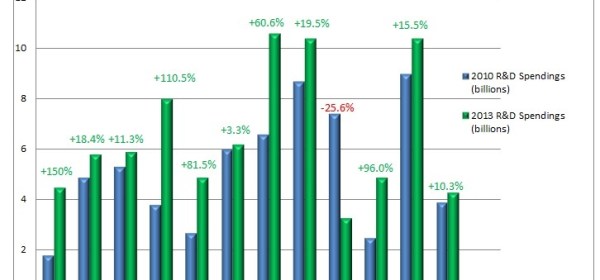
It is unclear that companies with the most significant increases in R&D spending are securing more, better quality or valuable patents. A random study of

The Supreme Court’s decision in Alice Corporation v. CLS Bank International, a case involving computer software, has led to a marked increase in patents being invalidated
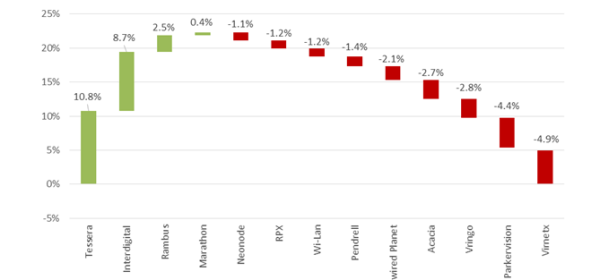
Despite a soft first quarter 2015 for the 13 IP licensing company stocks that comprise the PIPX IP Stock Index, versus the S&P 500, individual
There is a great deal of agreement that patent quality is lacking, but surprisingly little about how to define and achieve it. Patent quality is
The goal of the USPTO gathering is to promote discussion of ways to improve patent quality. The first Patent Quality Summit will take place at
 ipcloseup.com