
SpaceX’s galactic IPO is headed down to low Earth orbit. Its stock dropped 16.4% yesterday. But SpaceX is something to watch, and so are its cryptic IP rights.
Is SpaceX an opportunity to invest now in a tech giant representing the future of space entrepreneurism — or is it more about aggressive brand leveraging and the promise of a future that may never come to be?
It’s probably a little of each, but the unprecedented early stock market performance of SpaceX (NASDAQ: SPCX), whose market capitalization, $2.65 trillion last week has dropped by more than $600 billion as of this writing, still makes it one of the most valuable among all public companies.
The SpaceX IPO has not only made Elon Musk a trillionaire, it has enabled the company to be valued higher than many proven tech giants. Instantly, with modest revenues and no profits, it has become one of the most valuable companies in the world.
The frothy valuation for a company that lost $4.3 billion in the first quarter of 2026 has a lot more to do with the future and the Musk name and subtle trade secrets and Starlink subscriber base of 10 million than it does with tangible assets or a traditional balance sheet. IP rights play a role in this public company story, albeit an unusual one.
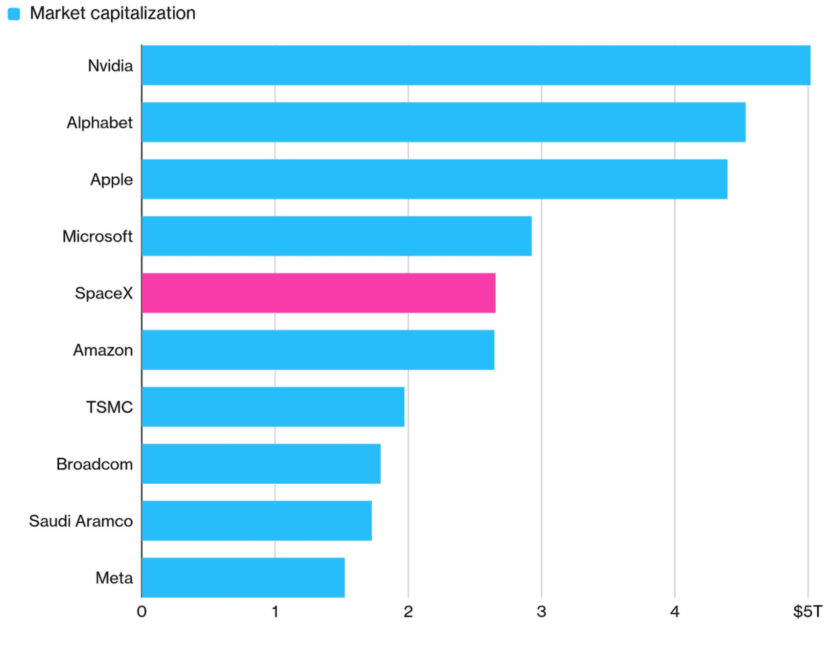
SpaceX’s valuation on June 17th, $2.65 trillion, enabled it to jump ahead of certified tech and energy giants like Amazon, Saudi Aramco, Broadcom, Taiwanese chipmaker TSMC, and Meta. The only companies worth more than the unprofitable SpaceX at this time are Microsoft, Apple, Alphabet and Nvidia. Pretty amazing.
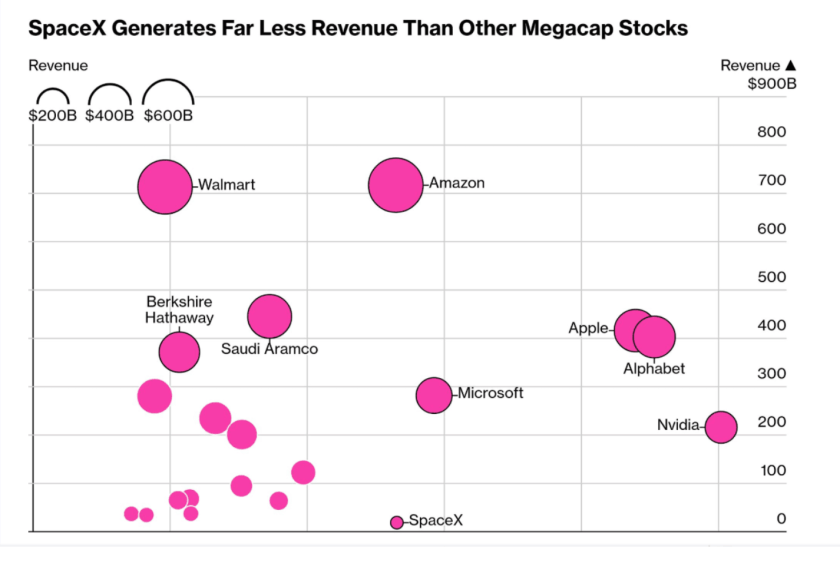
SpaceX achieved this on just $18.7 billion in revenue and no annual profits. Amazon had $717 billion in yearly proceeds. Only 4.2% of SpaceX’s shares are fully tradeable, reports Bay Area Times, creating exceptional demand.
(See the revenue vs. value graph below. The most valuable company, Nvidia, too, is not an income leader.)
Jaw-Dropping Valuation
Arete Research analyst Andrew Beale isn’t betting on rockets, at least not directly. Beale, a senior analyst at the firm, has been analyzing telecom and cable stocks since the 1990s. What makes his call particularly intriguing is that he’s betting on a satellite SpaceX hasn’t even launched yet.
While Elon Musk has repeatedly said that “patents are for the weak” (there is truth in that), he never said the trade secrets were for the strong. They are.
Beale tops Wall Street with a $401 SpaceX call. That target implies roughly 117% upside from a closing price of $185. At that level, SpaceX would carry a market valuation near $5.3 trillion, or about 80 times the company’s projected 2027 sales, Finbold reports.
Morning Star’s Nicolas Owens values SpaceX SPCX at $63 per share, a 53% discount to the upcoming IPO’s offering price. “Our valuation is the result of mathematics more than skepticism,” it reports.
The current price of SpaceX is difficult to justify by traditional measures,” says Jeff Sommer, who writes on markets, finance and the economy . “The company is losing money, but that’s the least of it. Perhaps most troubling is that an investment in SpaceX is an extravagant bet on a sci-fi dream.
“The company’s prospectus says clearly that SpaceX is dedicated to the ‘establishment of a permanent human colony on Mars with at least one million inhabitants.'”
IP Still Matters
Despite Musk’s pronouncements and SpaceX’s rapid rise the company’s intellectual property plays a significant if unobvious role in its valuation. While Elon Musk has repeatedly said that “patents are for the weak” (there is truth in that), he never said the trade secrets were for the strong. They are; and SpaceX apparently has many of them.
According to Claude, SpaceX relies on a combination of trade secrets, patents, licenses, know-how, copyrights, and, perhaps most importantly, trademark-protected brand for IP leverage. Strong brand (trademarked), in combination with trade secrets (know-how) and supported by patented inventions, can be a dynamic partnership. Just ask Coca-Cola, McDonald’s or Alphabet.
SpaceX is partial to:
“Trade secrets over patents,” reports Claude. “Rather than filing extensively for patent protection, SpaceX relies heavily on trade secrets, which keeps its technology out of public view but comes with trade offs since trade secrets only protect against misappropriation, not independent discovery.”
Elon Musk has been public for years about this preference, partly because patent filings would require disclosing technical details to the public — including to foreign governments and competitors such as China — that SpaceX would rather keep confidential. Despite that, IP rights clearly matter to the company. See: Spacexstock
ChatGPT says that SpaceX does hold patents, though fewer than many aerospace peers.
Public patent databases and industry trackers indicate that SpaceX is among the leading space-sector patent holders, with patents and applications covering areas such as:
-
- Reusable launch systems
- Satellite communications
- Optical inter-satellite links
- Reentry and thermal protection technologies
- Antenna and communications systems
Estimates range fairly widely: one analysis from early 2026 puts the portfolio at roughly 515 patents across 9 jurisdictions, with about 393 active, including both granted patents and pending applications (Claude).
About 79.5% of its patents focus on Starlink antennas, 13.6% on printed circuits.
SpaceX’s patents are concentrated almost entirely on Starlink-related hardware, not rockets. About 79.5% of its patents focus on Starlink antennas, 13.6% on printed circuits, with the remainder on transmission systems and waveguides.
Fewer Disclosures; Less Competitors
Musk has stated publicly that SpaceX doesn’t want competitors — particularly Chinese state actors — to use published patents “as a recipe book.” The downside is real: trade secret protection doesn’t guard against independent discovery or reverse engineering, and secrets can be leaked or stolen.
So, with strategic hardware patents and numerous trade secrets it is in the position to enforce, domestically at least, and a series of trademarked brands supported by a charismatic and proven tech entrepreneur, SpaceX stock is in the position to rock.
The company has many domestic and foreign trademarks on a variety of products and services, most especially its valuable name and the reputation of its ingenious founder, who established Tesla, the world’s most respected EV brand, owns X, still a highly popular social media platform, and co-founded PayPal, and has close ties to The White House.
Image source: Bay Area Times; The Street

