
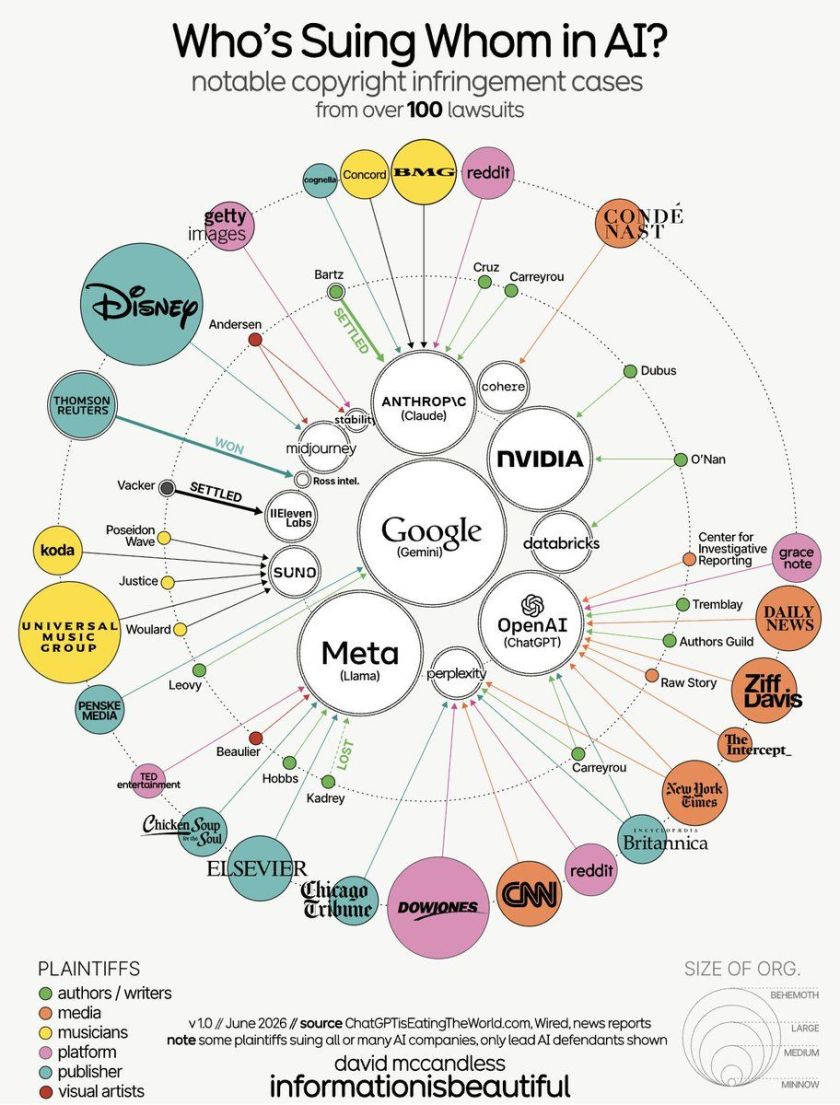
As of mid-2026 over 130 copyright-related lawsuits have been filed by a range of book, news, journal and music content holders against a handful of AI platforms and hardware providers.
Defendants include Google (Gemini), Meta (Llama), Nvidia, OpenAI (ChatGPT) and Anthropic (Claude).
The illustration above generated by David McCandless succinctly summarizes the AI litigation terrain, including the key players. Most importantly, the visualization identifies plaintiffs and defendants by industry (by color), name and size. The players are clearly laid out.
What we learn is, yes, there are a handful of LLMs who are treating copyrighted content used to train their models like it is there for the taking, and they are litigation targets. We also see that enforcement is coming from a range of content providers, from Disney, Dow Jones and Universal Music Group, to niche players, like the Authors’ Guild and the Center for Investigative Reporting.
Fair Use or Theft?
“AI ingestion of copyrighted works represents the biggest IP theft of all time,” says Keith Kupferschmid, President and CEO of the Copyright Alliance, a nonprofit representing 2,000,000 individual creators and over 15,000 organizations.
“All you need to do is look at the over 120 copyright infringement cases that have been filed against AI companies in federal court to understand just much the copyright community is in an uproar over AI companies’ taking of their copyrighted works without consent or compensation.
“With so many cases pending—all with different sets of facts and circumstances—it likely will be many, many years before the legal issues in these cases get decided with any finality. No doubt there will be certain instances where courts may conclude that the AI company’s use is fair use, but in the majority of the cases, especially cases involving news, music, audiovisual, and images, it’s more likely that the AI companies’ fair use defense fails.”
Training Models
These are complex suits involving content what is in fact available to train and be used by AI models. They will take years to resolve, but will no doubt pave the way for future treatment and, hopefully, greater respect for copyrighted works. In my opinion, these cases will also influence the unauthorized, often serial infringement of patented inventions.
The technology exists to track content and brand abuse, perhaps less so with patents. Were there more IP certainty, the law would be more of an open and shut matter. Uncertainty of rights and lack of consistent legal precedent benefits early movers and large incumbents, who avail themselves of the chaos, timeline and access to capital to maintain their leadership.
Fear of Opening the Door
On the part of LLMs there is fear of opening the door to standard or even compulsory licensing. As content and innovation grow at unprecedented speed, owners must find the tools to track use and hold users feet to the fire about compensating creators and owners. The Screen Actors Guild learned quickly its members needed to be proactive to assure not only their rights but their careers.
“AI ingestion of copyrighted works represents the biggest IP theft of all time.”
Without getting a handle of authorized use there is a distinct risk that a handful of large and a few small users will determine the future of music, images, written content, and secure an outsized role in deploying information and influencing culture.
There have been several notable settlements, including Bartz v. Anthropic (Claude) which resulted in a $1.5 billion settlement for authors, representing about $3,000 each for 500,000 persons for the right to use their content to train Claude.
Tip of the Iceberg
“Because of all the uncertainty, risk, and complexity, the best solution for all the parties involved is one that relies on free market licensing,” explains Kupferschmid. “We have already seen the beginning of this solution take hold, as many AI companies have reached licensing deals with copyright owners to use their works for training purposes.
“There are already thousands of deals that have been struck between AI companies and copyright owners, and this is just the tip of the iceberg. Expect more and more of these deals to be consummated over the coming months and years, including with individual authors through collective rights-type agreements.”
Image source: informationisbeautiful.net

