
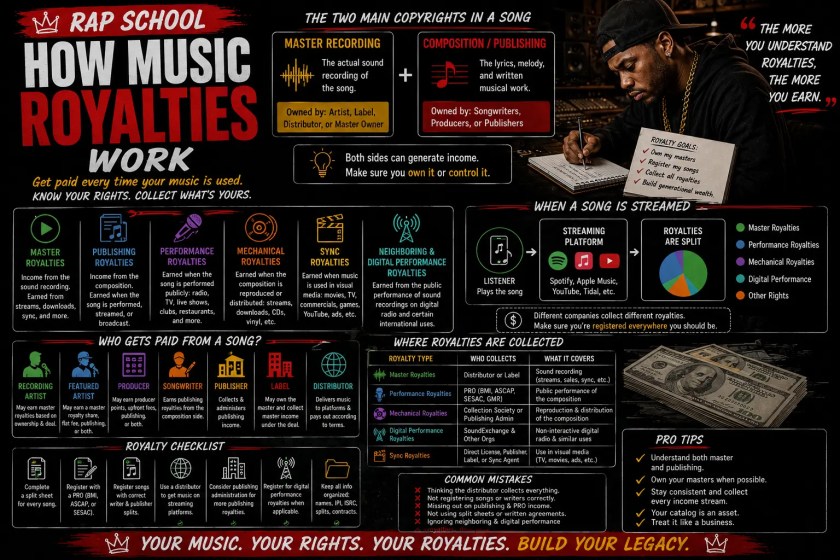
You may never listen to music or regard a record recording the same way again. This eye-opening infographic explains a lot in a small space. Full disclosure: It must be read carefully, line by line.
“How Music Royalties Work” from raptology.com deftly summarizes the complex payments made under copyright that literally every musician, wannabe player, songwriter, content creator and listener should be aware of. It is worth reading slowly. It will change some artists lives and, possibly, some listeners, too.
Music copyrights are not only important to song writers, recording artists and performers they are a vital way of understanding the importance and breadth of copyright, an essential property right that everyone owns but few realize they do, and some hugely profit hugely from
The Copyright Universe
Music copyright is not simple. It’s the way a half-dozen or more composers, recording artists, performers and labels can get paid, with significant overlap. Most require tracking by professional services in order to be properly compensated. Even non-entertainment industry lawyers find music copyright a challenge.
A childhood friend of mine who is a successful producer, performer and Manhattan recording studio owner, put it this way:
“There are some in the recording industry who would prefer artists be uninformed about how music copyright works and parties are compensated. Not all lawyers get it and sometimes their allegiances are not clearly spelled out. It’s often about partial ownership and making certain it is recognized.
“The royalties music publishing generates can be lucrative but not everyone is permitted to participate in them equally, at least not at first. Leverage begins slowly, usually, after some proof of success. People in the recording and songwriting who don’t understand the business get very smart, very quickly.”
To illustrate the economics: Reaching 1,000,000 streams typically generates about $3,000 to $4,000 in total gross revenue. The artist Drake generates over $10.5 million in a 28-day period. Taylor Swift and Drake, have driven lifetime streaming revenues estimated in the $400 to $500 million range. Most successful artists and acts generate a fraction of that, if they are lucky.
Types of music royalties:
- Master (sound recording)
- Publishing
- Performance
- Mechanical (reproduction or distribution)
- Sync (movies, TV, etc.)
- Neighboring and Digital Performance (digital radio – not AM or FM)
Who gets paid?
- Recording artist(s) (depends of the deal)
- Featured artist
- Producer
- Songwriter
- Publisher
- Label
- Distributor
I am not a fan of infographics that cram a lot of information onto a single page in hopes of explaining an idea or process. For “How Music Royalties Work” I am willing to make an exception. It is filled with important, basic information, distilled and dissected. It is an helpful overview, not a definitive education.
Leveraging an Asset
A while ago I wrote about David Bowie’s innovative debt financing (aka “Bowie Bonds”), based on a portion of his future revenue from 1997 to 2007, It provided upfront cash by leveraging the future royalties of 25 albums (about 300 songs) recorded before 1990
This was prior to a dramatic shift in music distribution and ownership. File sharing became rampant the 1990s. Bowie, smartly, never gave up ownership to his work, just the cash flow for a limited time on some recordings in exchange for an upfront payment of $55 million. It was more a gamble for the investors (Prudential Insurance) than Bowie, and worked out well for him. It paved the way for catalogue sales for Dylan, Springsteen and others, like Queen, which sold its catalogue to Sony Music Group in 2024 for $1.27 billion.
For the underwriters whose revenue projections were not met, and debt investors who purchased the bonds, there was disappointment. For Bowie, he was able to leverage assets without giving them up. He used his brand to create additional value for his copyright ownership.
Image source: https://raptology.com/

