
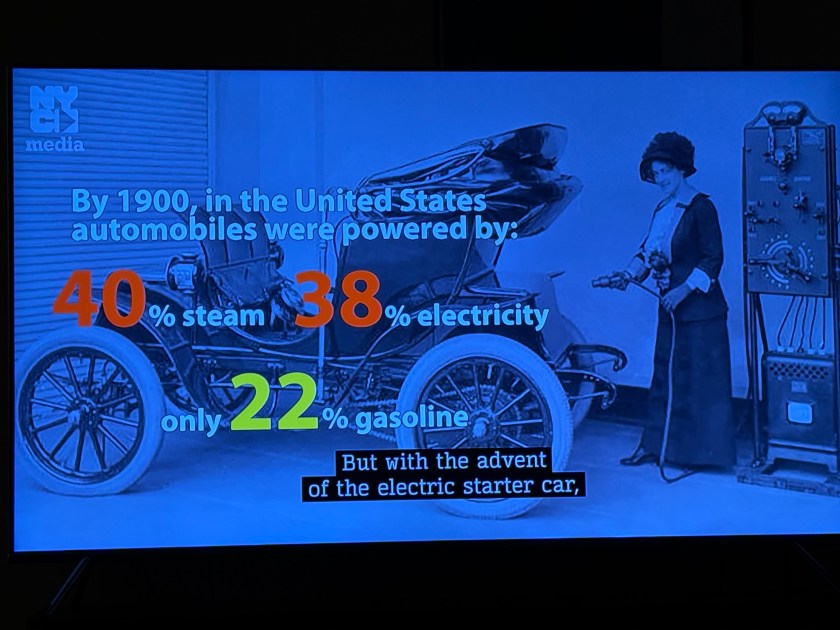
The use of electric cars in the United states peaked around the turn of the 19th century, over 125 years ago.
Battery-driven automobiles at the time had 38% market share, second only to steam, 40%. The gasoline powered combustion engine accounted for just 22% of engines at the time.
Historic accounts indicated that “Electric cars were quiet, clean, and easy to start, compared to steam and gasoline counterparts.” More about early developments in the overviews, History of the electric vehicle and Electric car.
Electric vehicles became possible in 1827 when Hungarian priest Ányos Jedlik built the first electric motor. The next year he used it to power a small model car run on a non-rechargeable battery. (Not exactly a disposable battery.)
The advent of the electric car starter in 1911 by Charles Kettering of DELCO was first used in production on the 1912 Cadillac Model 30. It replaced dangerous manual hand cranks, received a formal patent in 1915, and became standard on most new cars by the 1920s.
The system eliminated broken arms and injuries caused by engine kickbacks from manual hand cranks. By the 1920s, electric self-starters came standard on almost all new automobiles, which allowed women and elderly drivers to operate cars safely.
Early E-Car Developments and Patents
The earliest milestones for electric vehicles involved non-patented prototypes in the 1830s, followed by the first electric motor patent in 1837 (US Patent No. 132A) to Thomas Davenport), and later specific road vehicle and battery carriage patents heading into the late 19th century
- The breakthrough: Charles Kettering refined and miniaturized the technology through his company, DELCO, working alongside Henry Leland at Cadillac.
- The patent: Kettering officially filed and was later issued a patent for his engine-starting device on August 17, 1915.
Early Milestones in Electric Vehicle IP
- 1837: Thomas Davenport receives the first US patent for a foundational electric motor.
- 1840–1847: British and US patents are issued for rail-based electrical conduction and propulsion systems.
- 1890: C. J. Van Depoele is granted US Patent 422,266 for an electric railway motor car.
- 1890s: William Morrison files key US patent applications for early electric carriage battery systems and vehicle layouts.
- 1894: Pedro Salom and Henry Morris patent the Electrobat, leading to commercial urban electric cab fleets.
- 1904: Thomas Edison receives a key patent for an improved alkaline storage battery intended for an “Electrical Automobile”.
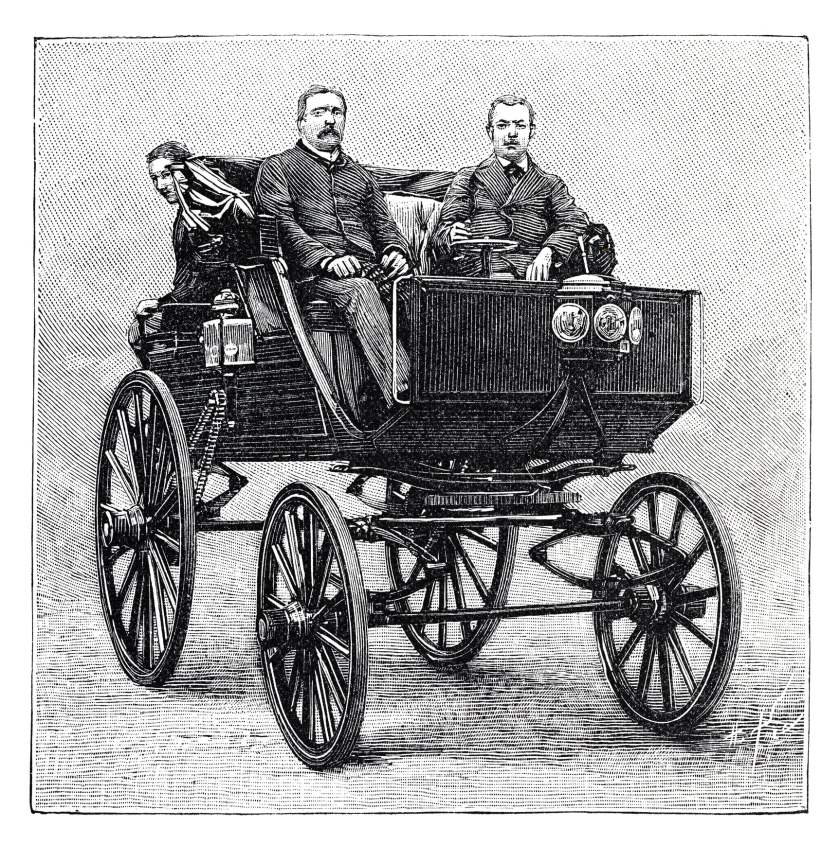
Historical engraving is the 1894 Paul Pouchain Electric Phaeton (France).
E-Vehicle Patent Trends Today
Current key electric vehicle (EV) patent trends center on advanced solid-state battery chemistry, dual-battery range management, Ai-driven power distribution, and aerodynamic design. Major patent portfolios are led by global automakers like Hyundai, Toyota, and component innovators like China’s CATL
- Hyundai Motor Group / Toyota: Lead overall application volume and powertrain/control integration frameworks.
- CATL / BYD: Dominate energy-storage and chemical cell-level manufacturing patent classifications.
- The 2026 e-vehicle patent landscape from Patsnap.

