
The U.S. and China lead in providing the biggest and latest AI models but according to recent research conducted by Microsoft they both lag in AI adoption.
It’s not clear what’s holding them back. It could be fear of sharing information, reluctance to infringe IP rights or the general lack of regulation. The EU has been most aggressive about regulation and adoption is generally higher.
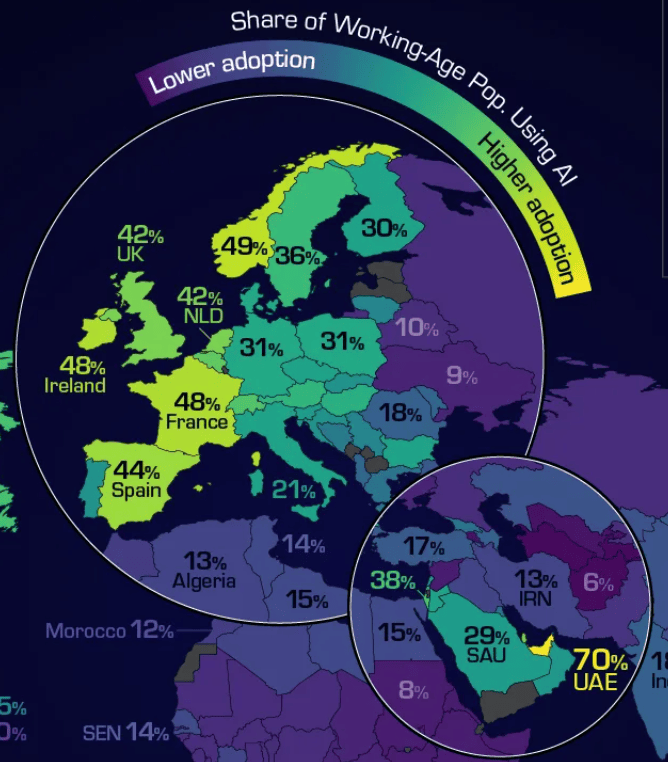
The map below shows the share of countries’ working-age population using AI tools in Q1 2026, based on Microsoft’s Global AI Diffusion Q1 2026 Trends and Insights. It is based on users engaging with AI for at least 90 minutes per month.
Microsoft is likely sensitive to the slow adoption. It has invested over $13 billion directly into OpenAI, alongside massive capital expenditures (CapEx) exceeding $100 billion to $145+ billion toward data centers, servers, and AI infrastructure buildout for Azure.
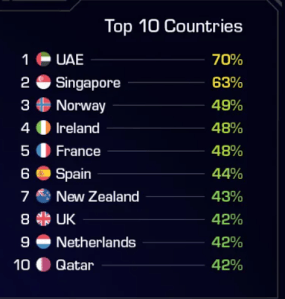
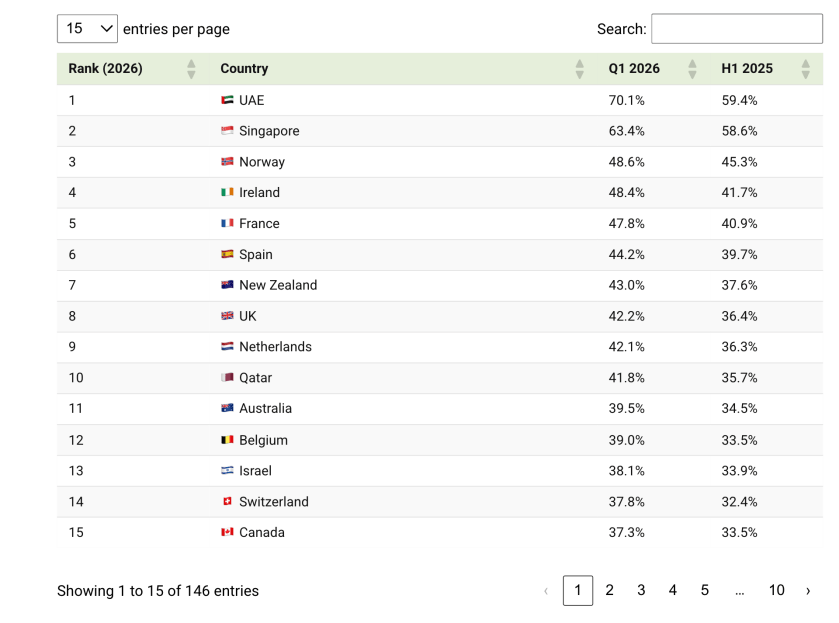
The UAE leads the world in AI use by a wide margin, with more than 70% adoption, followed by Singapore at 63%. Meanwhile, the U.S. at 31.3% ranks trails 20 other countries in AI adoption, despite being home to many of the world’s leading AI businesses. AI usage in South Korea increased 43.2% between the first half of 2025 and Q1 2026, the largest increase globally.
Open Source Models in China
“China remains relatively low [regarding AI adoption] at 16%, but its scale means even modest increases in could rapidly add hundreds of millions of new AI users,” notes the Global AI Diffusion Report by way of the Visual Capitalist.
Like the U.S., China plays a leading role in AI model performance (and investment), particularly in open-source models, yet actual use remains lower than many regional peers. China is ranked 69th in adoption globally.
What do early AI adopters see that others do not? Possibly, the opportuning to catch up to world economy leaders by doing things differently earlier. They may be more confident about using AI safely due to local regulation and there may be financial incentives.
Building vs. Using AI
The data a suggests a growing divide between building AI and actually using it. While America dominates AI model development, chip design, and funding, several smaller economies are integrating AI into everyday work-life at a faster pace.
The nations most actively embracing AI are not leading AI investors.
AI adoption is also highly uneven across the nations, such as the U.S. Regions with dense tech ecosystems and high concentrations of digital talent are seeing significantly stronger usage rates than less digitized states. One separate study found that 22.4% of workers in Washington state use AI, compared with just 13.1% in South Dakota.
High-Adoption Economies
Higher-adoption economies suggests the Microsoft report tend to share several traits: strong internet infrastructure, service-heavy economies, high digital literacy, and significant investment in cloud computing and AI education.
For the full story and interactive AI adoption ranking, go here.
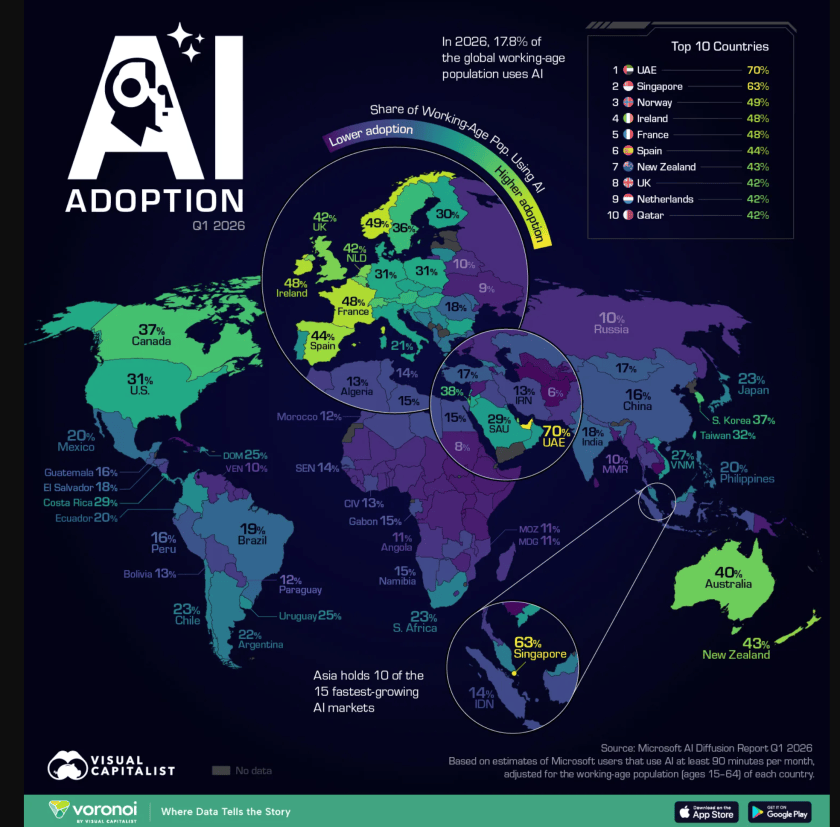
Image source: Voronai.com

