
Why do intelligent people, many with advanced degrees and business experience, fail to get the purpose and benefits of IP rights? Where’s the disconnect”
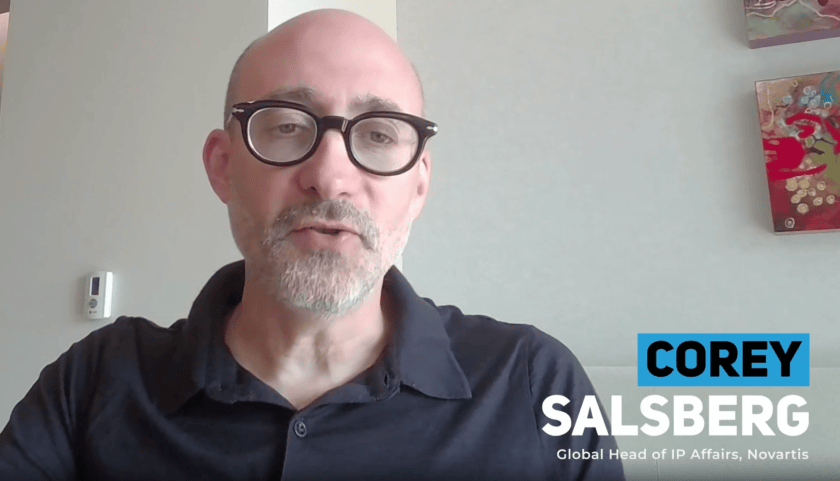
One of the best infomed and most articulate purveyors of the intellectual property world, Corey Salsberg, says it has more to do more with how the IP story is being conveyed than the facts, which should speak for themselves but often don’t.
Salsberg, Global Head of IP Affairs for Novartis, believes that the IP “story” – its history, what it means innovation, businesses and society – is not being communicated effectively.
“Millions of people who have never read a patent still own a pair of jeans held together by a rivet a poor tailor patented in 1873,” explains Salsberg.
“They have watched Marvel movies without knowing that Marvel’s entire business rests on intellectual property law. They take aspirin without realizing it was one of the first products of the modern patent system. Intellectual property is everywhere, quietly shaping the products people use every day.”
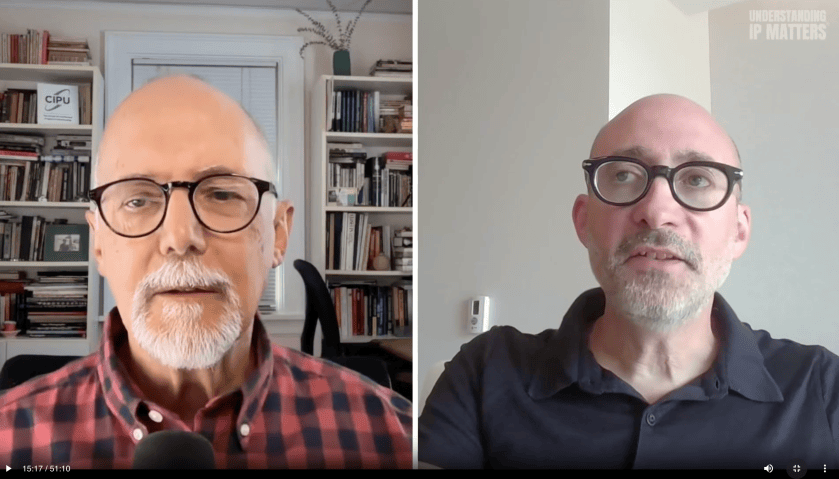
That IP disconnect is the subject of a wide-ranging conversation between me, Bruce Berman, host of Understanding IP Matters, and Salsberg, an articulate purveyor of not only patents, but trade secrets, trademarks and copyrights.
He has built a reputation as a thought leader in IP innovation, law, and policy, known for a particular philosophy: the goal isn’t to tell a more attractive IP story, it’s to convey an accurate narrative in more compelling and sustainable ways. These include real-life inventor and creator stories.
Listen now or download “Bridging the Disconnect – IP Memes Matter,” on the platform of your choice: https://www.buzzsprout.com/1537696
Watch the podcast here: https://www.youtube.com/channel/UCZk165UL2V8fNiJjVcQtnmQ
More IP-Driven Industries
Roughly one third of the American workforce is tied up in IP-driven industries. IP is connected to over 90 percent of S&P 500 value and more than 44 percent of American GDP. And yet, Salsberg points out, the average person, and even the average member of Congress, has essentially no education in intellectual property and does not appreciate its role.
Salsberg estimates that out of 535 members of the US Senate and House combined, only around 10 to 12 are genuinely educated on IP issues. That gap exists despite intellectual property being written directly into the Constitution.”It’s both an education and a communication problem,” he says.
Salsberg concedes the IP industry – inventors, content creators, owners, lawyers – has been particularly ineffective getting beyond the IP headlines, which tend to focus on costly disputes between big companies.
“IP people are very bad as a community at sound-biting important information,” he says, arguing that the field’s technical complexity is no excuse for not resonating with people.
Salsberg compares AI to earlier tools that augmented human ability, like a microscope extending human vision or a forklift extending human strength. “There is a human somewhere in the loop,” he says, and he expects that will remain true.
He draws a parallel to using lab mice to generate antibodies. “Nobody credits the mouse as the inventor, because it’s the scientist who recognizes and appreciates what has emerged.”
A Bridge, Not a Barricade
Framing patents as an economic bridge rather than a barricade can help build common ground with people who hold anti-IP views.
Salsberg pushes back on the common perception of patents as monopolistic barriers rather than tools – limited periods of exclusivity that provide incentive – that can level the playing field, attract investment, and encourage sharing. He attributes some of this resistance to basic human psychology.
“People are generally poor at prioritizing long-term interests over immediate wants, whether the issue is climate change, national debt, or access to a new medicine.”
Finding Common Ground With Adversaries
Rather than treating critics of IP as adversaries, Salsberg advocates for finding common ground through direct conversation. He shares that his own path into patent law was shaped by personal loss: his father died within a year of a brain tumor diagnosis, which motivated Salsberg to work in an industry dedicated to developing new medicines.
He argues that even fierce critics of the pharmaceutical industry share the same underlying goal: the delivery of effective, accessible medicine.
The disagreement, he says, usually centers on how access should be funded and whose responsibility that is, not on whether new medicines should exist at all. Finding that shared ground, he suggests, opens the door to solutions that entrenched positions tend to foreclose.
Making IP Part of Everyday Education
Salsberg closes with a case for embedding IP and innovation education into general schooling, not just for aspiring inventors and entrepreneurs, but for everyone.
He also sees an unexpected upside in AI’s rise: as content generation becomes easier, more people are becoming creators of copyrighted material, not just users of it, which he believes will make more people naturally invested in understanding how IP protections work.
Listen to the Full Episode
Bruce Beman’s conversation with Corey Salsberg is available now on Understanding IP Matters on all major podcast platforms. Visit understandingip.org to subscribe and explore the full archive of episodes.
Listen – “Bridging the Disconnect – IP Memes Matter,” on the platform of your choice: https://www.buzzsprout.com/1537696
Watch the podcast https://www.youtube.com/channel/UCZk165UL2V8fNiJjVcQtnmQ
Understanding IP Matters is produced by the Center for Intellectual Property Understanding (CIPU), a nonprofit dedicated to building awareness of intellectual property and its role in innovation, business and society.
Image source: CIPU

