
Despite an unprecedented increase in the number and value of intangible assets, like patents, trade secrets and trademarks, especially for the biggest, most valuable companies such as Apple, Alphabet and Amazon, exposure to IP is not required to earn a graduate business degree.
Intangible assets, which elude most company balance sheets, also evade the curriculum of elite business schools. The historic emphasis on managing tangibles is significantly less relevant today with the predominance of IP assets. Intangible Asset Market Value (IAMV) today constitutes 92% of the S&P 500 Index companies. Just 8% is attributed to tangibles, like real estate and equipment .
It would stand to reason that if the value of factories and equipment are no longer where the action is, and intangibles are, that students being prepared for a career in management, consulting or finance would require at least some exposure to IP rights. It would help to avoid the on-the-job IP disasters that require managers to get smart, quickly.
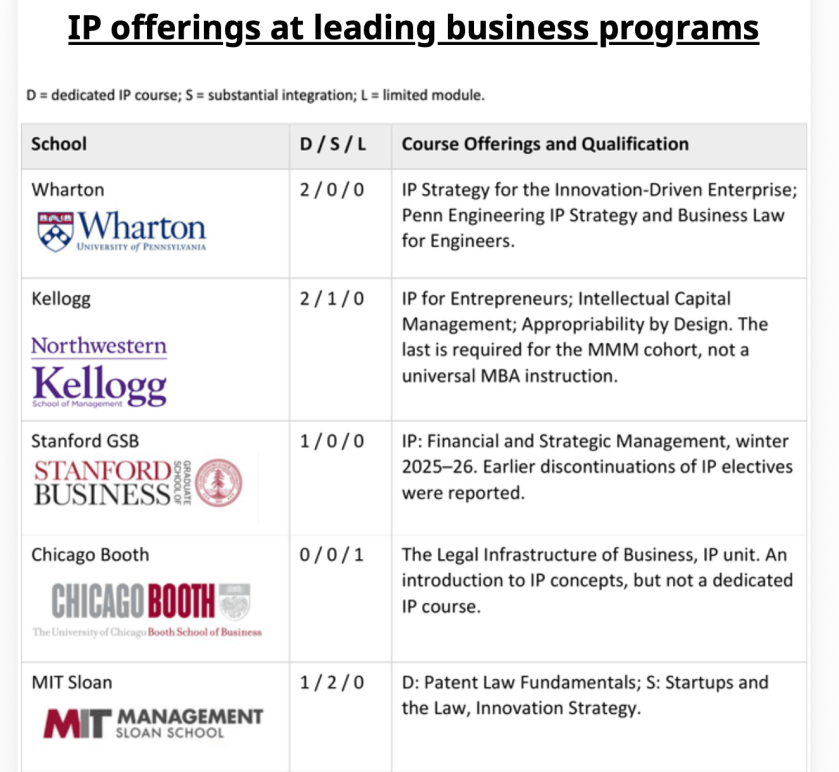
According to a new report, Intellectual Property Education at Leading Business Schools – 2026 Update, conducted by the Center for Intellectual Property Understanding (CIPU), a nonprofit, not a single leading MBA program requires students take an IP or other course that includes IP content to be awarded a graduate degree.
MBA graduates who will go on to manage significant businesses, people and transactions are not being prepared to work with intangible assets or IP professionals.
Failing IP Grades
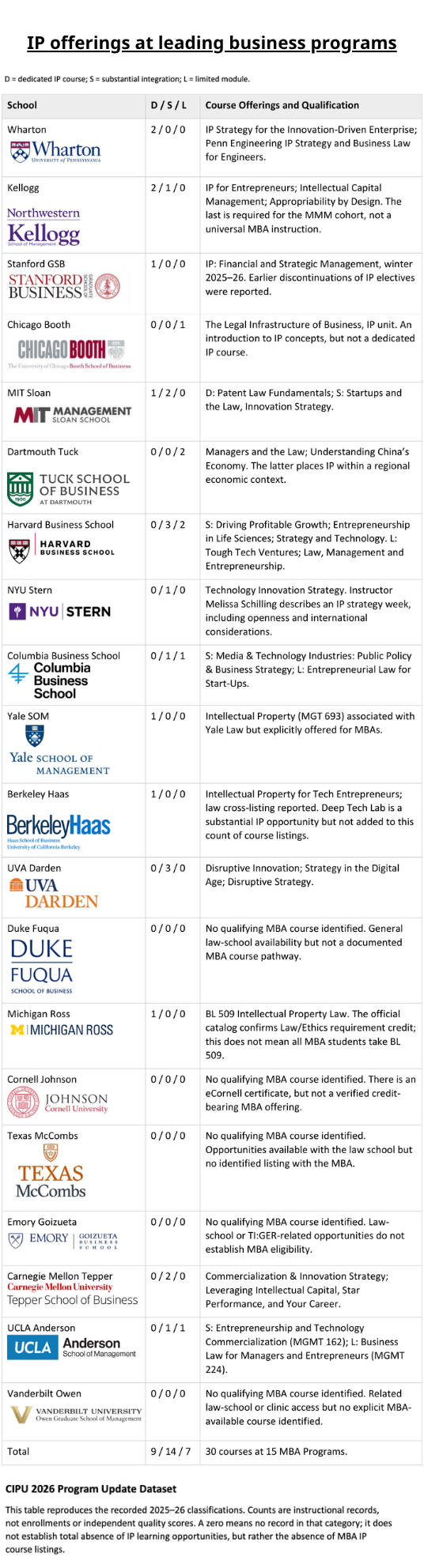
The new report on instruction at the top 20 U.S. business schools, which was released this week, finds more and better courses are being offered graduate business students about the meaning, use and value of intangible assets, but that a quarter of schools surveyed offer no IP or related courses.
“Business students having completed MBAs, many of whom will be leading major corporations or engaged in finance and transactions, need to be prepared to work with technology, legal and market specialists to function in a world of intellectual property rights and AI,” the report finds.
“Dedicated strategy courses, instruction embedded in growth and innovation electives, and interdisciplinary commercialization programs connect IP with the decisions business students are preparing to make,” the 2026 report states. “As AI and data become increasingly embedded in business, that capability deserves greater curricular attention.”
A quarter of schools surveyed offer no IP or related courses and none require one to graduate
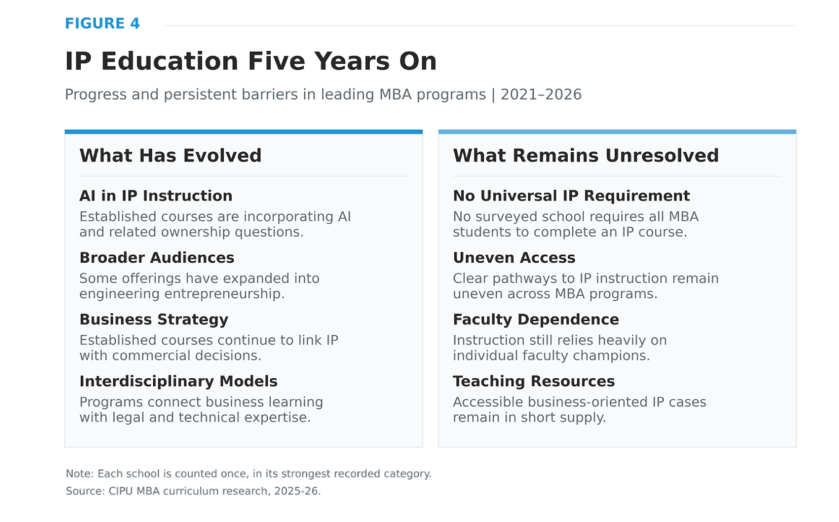
In a 2021 a predecessor report that covered similar ground described a growing scenario for IP education, Intellectual Property Education at Business Schools: An Evolving Landscape. The follow-up research shows that only some progress has been made, despite the increased relevance of intangibles.
Theory vs. Practice
“The new report, which I thought was well conducted, points out one other glaring shortcoming: the lack of faculty with real, practical operational experience,” said Brian Hinman former IBM licensing executive, Chief IP Officer at Philips and an MBA holder. “Much of the theoretical research on patent valuation, IP strategy, etc., is built on just that, how things are ‘supposed’ to be versus reality in a business setting.”
Discussions included in the report with seven esteemed IP academicians cited, some with hands-on IP licensing experience, convey the importance of sustained student interest, expansion to new audiences, and active adaptation to AI. “The opportunity now is to extend those strengths into a more consistent foundation for MBA graduates,” states the report. One-quarter of the top 20 programs examined offer no IP courses or integration with other courses. About the same percentage as 2021.
Needed: A More Layered Approach
“The response to these findings suggests a layered approach is needed, introducing IP to MBA students through repeated application in established business subjects [not just stand-alone courses] and accessible opportunities for specialist and experiential learning,” the report concludes.
“The goal is a generation of managers better equipped to recognize opportunity with intangible assets, protect valuable knowledge, negotiate access, and connect innovation with commercial success.”
See the full report and its appendices here.
Image source: Center for IP Understanding (CIPU)

