
Rapid changes in technology and less tolerance for financial risk have forced businesses in some industries to re-examine their business models and how they use and value their patents, trade secrets and other IP rights. Strangely, many of these developments are good for IP rights.
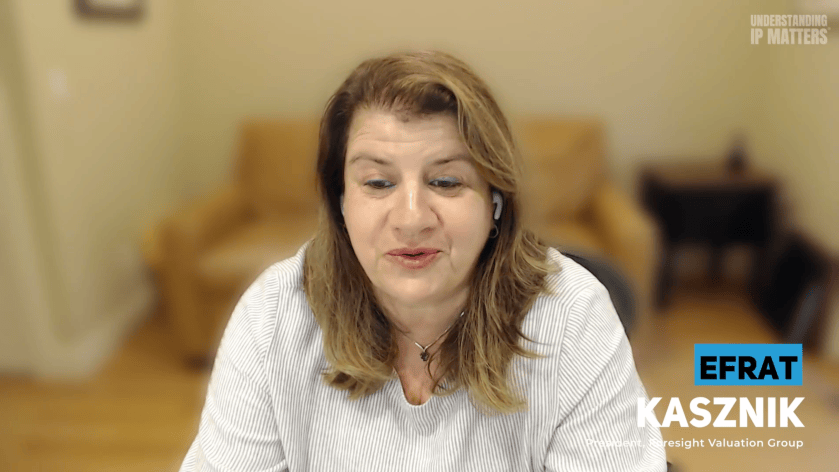
I sat down recently with Palo Alto-based Efrat Kasznik, President of Foresight Valuation Group and a Stanford Business School educator for the past 15 years, to discuss where IP value is today and which businesses are evolving with the changes. The Understanding IP Matters episode is called “Taking IP to the Bank,” and it it available on video and audio.
As an IP valuation expert, Efrat is perfectly positioned on the frontlines of young and big company financings. She sees where IP rights play a role and how — apparently more today and in subtler ways than we think.
“Patents are experiencing a renaissance after years in which many of the highest valued software unicorns barely relied on them at all.”
Of utmost importance for still private companies like the 1,300 Unicorns (those who valuation exceeds $1 billion) is queueing up to exit by engaging with a buyer or selling shares to the public.
In biopharma,” explains Efrat, “there is a clear reliance on patents and trade secrets. Semiconductors and hardware, too. SaaS and software in another matter.”
Investors are Rethinking What Patents are Really Worth
“A startup can file 300 patents, one in every country in the world, and still end up in bankruptcy court unable to sell a single one,” says Efrat. “A pile of patents is not the same thing as value. What matters is whether intellectual property is tied to a product, a market and a business model that actually works.”
What IP is actually worth to the people writing checks right now? Sitting between investors, lawyers and the companies caught in the middle, gives Efrat a uniquely unsentimental read on where the money is actually going.
Efrat describes today’s investment landscape as “sharply bifurcated.” Where capital once spread broadly across software as a service, “it now concentrates heavily,” she estimates, “around 70 percent, into a handful of categories: AI, cybersecurity, deep tech [semiconductors and related hardware], and defense.”
__________________
KEY DISCUSSION TAKEAWAYS
- A patent portfolio only has value if it is tied to a real product and a viable business model.
- Investors are currently concentrating roughly 70 percent of funding into AI, cybersecurity, deep tech and defense.
- SaaS companies face a difficult shift from fixed subscription pricing to usage based AI pricing, and investors can tell the difference.
- Data itself is hard to protect through patents or copyright, so companies lean on contracts and trade secret law instead.
- Many companies only discover what trade secrets they actually have once litigation forces them to make a list.
- IP backed lending is becoming a real option for companies trying to stay private longer without raising new equity.
__________________
Investment in defense, she notes, is being driven largely by geopolitical tension, with companies like Palantir having paved the way over the past decade or so. Life sciences remains its own steady category, with its own cycles, heavily reliant on patents regardless of broader market trends.
Wherever there is heavy R&D, patents tend to follow, which is part of why patents are experiencing what she calls a renaissance after years in which many of the highest valued software unicorns barely relied on them at all.
Data: Valuable to Have but Hard to Own
One of the more counterintuitive points Efrat makes is that data, despite being treated as a hugely valuable asset, does not fit cleanly into traditional intellectual property categories.
Copyright requires some kind of original compilation, not just a raw body of data. Patents are not well suited to protecting data either. “In practice,” she explains, “data protection mostly falls back on contract law and trade secret practice, reinforced by cybersecurity measures that guard against breaches or employees leaving with sensitive information.”
That is part of why trade secret litigation remains active and, in her words, is not actually new, even though the stakes feel higher now with cases like Apple’s litigation against OpenAI drawing public attention. The underlying driver, she says, is simple: people change jobs, and remote work has made it harder to keep data inside a single physical perimeter the way companies once could with on site mainframes.
An Exit Bottleneck is Causing Companies to Rethink IP
Investors, Efrat says, are always looking for one thing above all: an exit, and ideally one at a strong multiple. The traditional venture model assumes most portfolio companies will not make it, with only a small fraction delivering a real return.
That makes the current environment especially painful. Many companies raised money in 2020 and 2021 at valuation multiples that have simply not held up, leaving what she describes as roughly 1,300 unicorns stuck waiting for an exit, a large share of them SaaS companies whose valuations have not survived the shift toward AI.
This is where IP has found a surprising new role: Efrat sees companies leveraging patents and other intellectual property to secure a higher multiple in M&A deals that may come earlier than originally planned. She is also seeing companies patent in industries that would not traditionally be associated with intellectual property at all, mental health care among them, specifically to differentiate themselves in a crowded, capital constrained market.
IP Backed Lending is Emerging at a Financing Tool
For companies trying to stay private longer without raising another round of equity, Kasznik points to a growing trend: IP backed lending. Private equity firms, whose business model is fundamentally about lending rather than equity investment, are increasingly willing to treat intellectual property as collateral.
The challenge, she notes, is that valuing that collateral is genuinely difficult, and a lot of private equity firms that built their businesses on far more conventional assets, furniture companies, refrigeration businesses, are now finding themselves holding patent portfolios they do not know how to evaluate.
Trade Secrets are Often Stealth Assets
“Companies generally do not maintain a running inventory of their trade secrets the way they might track patents,” explains Efrat. “Most of the time, a company only figures out what trade secrets it actually holds when it needs to, whether that is during litigation after a misappropriation, or when raising funding and needing to describe the full scope of its technology to investors.”
Manufacturing processes are a common example: something that cannot easily be detected from the outside, so there is little point patenting it, which makes trade secret protection the more natural fit.
Valuing those trade secrets usually comes down to context. Without a direct link to revenue, Efrat often relies on a cost based approach, looking at what it would have cost to develop the technology or how much time a company saved by having it, sometimes described as the value of “negative know how,” the hard won knowledge of what does not work, gained from years of trial and error that a competitor would otherwise have to repeat.
Looking Past the Balance Sheet
Efrat also addresses a longstanding frustration in IP circles: internally developed intellectual property never appears on a company’s own balance sheet, and even intellectual property identified during an acquisition often gets absorbed into the catch all category of goodwill. Accounting’s foundational principle of conservatism, she explains, means a company cannot recognize a speculative gain in value it did not actually pay for.
The result is that a meaningful share of an acquisition price often reflects the buyer’s own complementary assets, distribution channels, infrastructure, existing customer relationships, rather than the IP itself.
Because that accounting reality is unlikely to change, Kasznik argues investors ultimately have to look past the balance sheet. What convinces them, she says, is not a general claim about strong IP but concrete, comparable numbers: what similar companies with similar IP have actually sold for, what licensing deals have paid, and what multiples other buyers have been willing to pay in the market.
Listen to this Episode
My full conversation with Efrat Kasznik on Understanding IP Matters on all major podcast platforms. Visit understandingip.org to subscribe and explore the full archive of episodes.
Understanding IP Matters is produced by the Center for Intellectual Property Understanding (CIPU), a nonprofit dedicated to building awareness of intellectual property and its role in business, creativity, and innovation.
Image source: Center for IP Understanding (CIPU)

