

Millions of people carried a Sony Walkman through the 1980s without knowing that the magnetic tape head inside it traced back to a patent filed by an inventor working out of an attic in suburban New Jersey.
That same inventor, Jerry Lemelson, also held patents associated with the machine vision systems that let cameras flag defects on a factory line, and the flexible manufacturing concepts that allowed a single production line build dozens of different product models instead of one. By the time Lemelson died in 1997, he held roughly 600 patents, making him second only to Thomas Edison at the most prolific American inventor of the 20th century.
First Hand Account
On the most recent episode of “Understanding IP Matters,” which dropped today, I speak with Rob Lemelson, award-winning research anthropologist, documentary filmmaker, UCLA professor, and innovation advocate, about growing up the son of a man who spent nearly every waking hour with a notepad in hand coming up with better ways to do things.
Rob has produced and directed the revealing Patent Man, a film profiling his father built in part from hundreds of hours of videotaped deposition footage, home movies and reenactments. “What it was like to grow up around a star inventor,” I ask.
“He was a good father who included my, brothers and me in some of his earlier projects,” say Rob. “He wanted to know what we thought. But he was a 24/7 inventor, always active and always thinking. He was interested in almost every type of machine and process. His early inventions involved toys and others involved medical devices and manufacturing.”
Lemelson’s inventions are associated with warehouses, industrial robots, cordless telephones, fax machines, videocassette recorders, camcorders, and the magnetic tape drive, as well as games and toys.
Some businesses held it against Jerry for not commercializing and manufacturing his inventions, as they did theirs. But his genius was not for bringing products to market. It was in getting good inventions detailed and properly filed with U.S. and other patent offices as soon as possible. Rob reminds me that it took a lot for an independent inventor to compete against companies with far more legal expertise and resources.
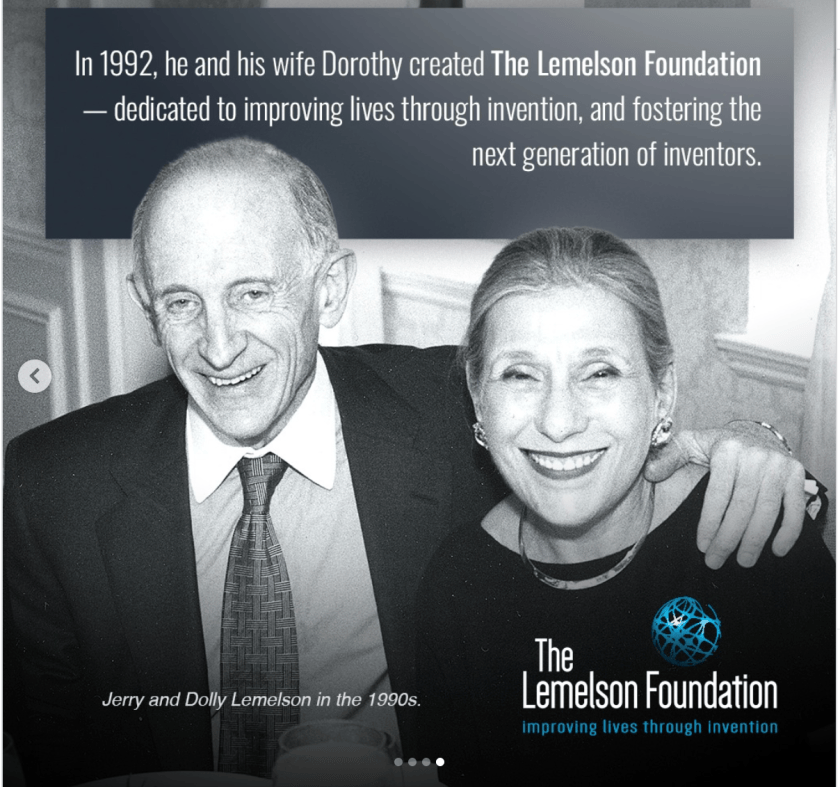
The Lemelson Foundation
In 1993, before Jerry’s passing from liver cancer four years later, he and his family established established the Lemelson Foundation, a philanthropy whose mission is to support invention and innovation to improve lives in the United States and developing countries. He was an advocate for the rights of independent inventors because who knew what a reliable patent system meant to them, to innovation and democracy.
The Lemelson Foundation supports Lemelson MIT young inventors’ program, VentureWell and the Smithsonian Institution, among many others.
“It was never about money, for him,” explains Rob. “We lived a middle class existence in Metuchen, NJ. It was more about new ideas and sharing them. If they required litigation he might engage in it, but it was certainly not something he sought or took pleasure in. It kept him away from what he loved most.”
His first invention, as a child, was for a lighted tongue depressor that his father, a local physician, could use. His first major invention involved utilizing a universal robot, for use in a variety of industrial systems, that could do numerous actions such as welding, moving and measuring products, and utilized optical image technology to scan for flaws in the production line.
Jerry licensed many patents to IBM, Sony and Texas Instruments, among others. An exhibit of his toy inventions was shown in 2012 at the Smithsonian National Museum of American History.
It was only later in his career that he was involved in a series of patent litigations and subsequent licensing negotiations. As a result, he was denounced by his legal opponents and at the same time hailed as a hero by many independent inventors.
Listen or watch here the my discussion with Rob Lemelson:
Audio – https://www.buzzsprout.com/1537696
Video – https://www.youtube.com/channel/UCZk165UL2V8fNiJjVcQtnmQ
Patent Application Delays
Lemelson earned three engineering degrees but was accursed of finessing the patent system with continuation applications as a result of long Patent Office delays. That was legally acceptable but frustrating to those late to the party or who did not understand it. These applications established early priority dates, which provided patents with broad claims coverage that were impossible for new developments not to acknowledge.
Jerry filed suit on the “flexible track” used in the popular “Hot Wheels” toys manufactured by Mattel in the1980s for willful patent infringement (triple damages), from which he initially won $24.8 million a jury trial. This case was later overturned on appeal. Later that same year, Lemelson won a $17 million judgement against Illinois Tool Works for infringement on a robot tool spraying device, which was upheld.
Image source: Center for IP Understanding

