
When is a win not a win? Apparently, when it is a large patent damages award.
Why bother? That is the reaction of many infringed patent holders after having their multimillion dollar damages awards thrown out, settled or otherwise vacated. Unfortunately, people seldom read beyond the headlines about the initial win.
The cost, time and risk of securing a large award on even the most egregious patent infringement is often not worth it, so many do not bother to file. Those that do believe they have a shot are often disappointed. Litigation funding firms, that loan money to the best case scenarios, fund on average 5% of the suits they see. Selectivity is built into their survival.
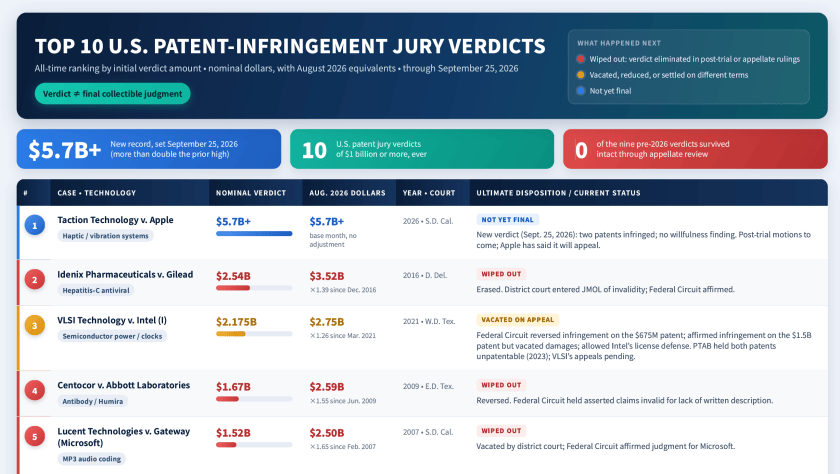
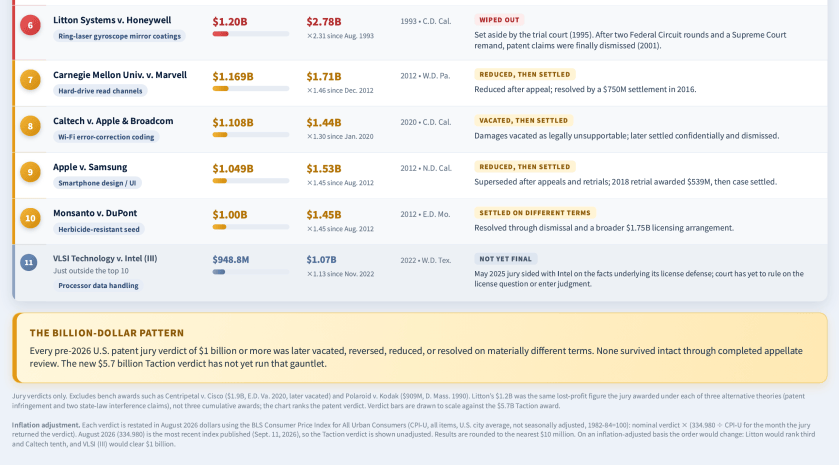
While big damages awards frequently dominate the news, virtually none of these peak jury awards are paid out because they are routinely reduced, vacated, or overturned on appeal. The ten largest awards on record, ranging from about $1 billion to over $3 billion have not been paid.
At one time payouts were less rare, especially when giants sued one another. Among those cases where damages were actually paid:
Eastman Kodak paid Polaroid $925 million on July 15, 1991 to settle a 15-year patent infringement lawsuit over instant photography technology. That’s $2.35 billion in 2027 dollars was paid and remained the largest payout for decades. (I was peripherally involved in the aftermath of this case. Kenyon & Kenyon, Kodak’s litigation firm, mitigated hundreds of million of dollars in potential damages, but no one remembers that. My firm was asked to quietly help to convey their skill and otherwise good reputation.)
Apple vs. Samsung (2012–2018): After an initial $1.05 billion jury verdict for smartphone design patent infringement, years of retrials and appeals concluded with Samsung paying $539 million in damages.
One of the largest settlements actually paid in a patent infringement case was the case between Apple and Qualcomm. In April 2019, as part of a settlement to end all ongoing litigation between the two companies worldwide, Apple agreed to pay Qualcomm an estimated $4.5 billion to $4.7 billion. This settlement was significant not only for its size but also because it marked the end of a contentious legal battle over patent licensing fees and technology patents related to mobile devices.
The Impact on Innovation
The impact on the inventors and companies that hold the patents is palpable, but what is the impact on innovation, when valid, commercially successful inventions can be copied or otherwise used with impunity? It is not healthy for innovation or competing businesses.
What’s the answer? Aim lower despite the actual damages incurred and maybe win more frequently?
I am concerned when infringing businesses with unlimited capital for legal defense can effectively determine the nature of what is innovative and who controls successful inventions by drawing out the timeline, we are in dangerous waters.
It is not just about big players getting bigger, but undermining inventions that benefit products, consumers, invstors and society.
The days of bloodless licensing on practical business terms are over. Creative destruction (via Austrian economist Joseph Schumpeter) is seen as a threat to incumbents, not a breakthrough opportunity waiting for the light of recognition.
Making life impossible for potential licensors impacts businesses and consumers in ways that are not immediately visible.
Image source: ClaudeAI

