

In the tech world the line between fact, fiction and fraud can be difficult to discern. The movie about Elizabeth Holmes and her family, You Can See Everything, turns that line into a kind of theater that is both compelling and insightful.
The movie portrays Elizabeth as she prepares to serve an 11-year prison sentence for defrauding high-profile investors of some $700 million. Viewers find it difficult avert their gaze from her crime, the failed technology and wide-eyed gaze in this almost three hour film that is less documentary than a provocative, semi-fiction portrait to which viewer response differs.
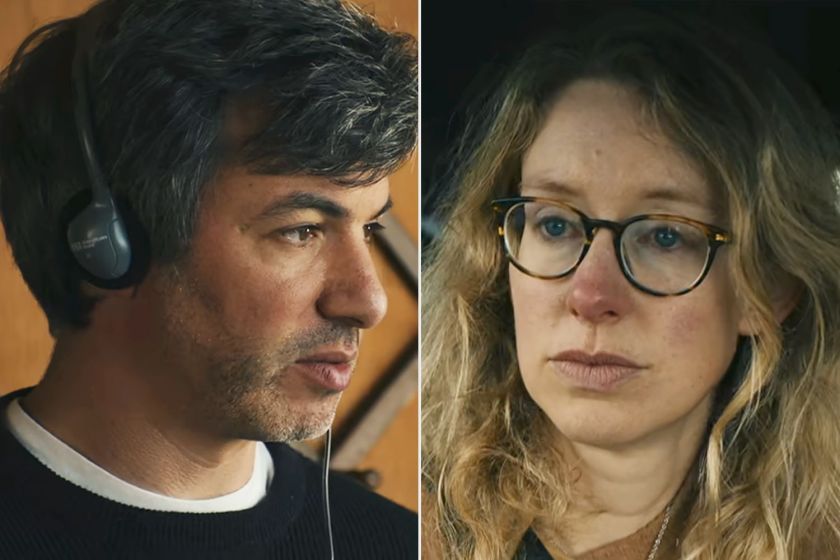
The film’s truths are less about Elizabeth’s guilt and more about her enigmatic persona and responses to it. How filmmakers Nathan Fielder and Lance Oppenheim see her and present the truth is unique and captivating. No documentary in years has received this much positive attention, both critically and at the box office. The film’s current grosses exceed $100 million. It’s production budget was $7 million.
You Can See Everything is a thought-provoking amalgam of documentary fact and cinematic flair, where the camera might not lie but the characters probably are. Included in this multi-layered exploration are fictionalized re-enactments orchestrated by a co-director best known for his work in comedy.
To say this film touches a nerve is an understatement. Viewers can’t get enough of it. But they often come away more confused about the truth than convinced about the facts.
Co-directors Fielder and Oppenheim are poking fun at traditional documentary filmmaking as much as allowing Liz and Billy to reveal themselves. A candid shot of naked Billy in the shower seems gratuitously included for comedic effect but it is among the most revealing images in the film.
In You Can See Everything views see a lot but, in the end, maybe nothing definitive – only what various players present and we interpret.
Home Sweet Holmes
The fictionalized segments – some of which are stated – may be more truth-revealing that the Cinema Verite footage shot in low light. The portions filmed in Holmes’ rented home, starting 34 days from an 11 year incarceration in a Texas jail for defrauding high-profile investors of more than $700 million, are theater, and Elizabeth, her husband, Billy Evans, and their two beautiful children willing players.
Whether or not Elizabeth is guilty of fraud is not the focus of this film. Her and her husband’s charisma is. They are shown as an attractive couple, she as a breastfeeding mom about to go to prison for a crime she does not believe she commited and for lies and half-truths she does not believe she perpetuated. That her victims are some of the most celebrated people in government, law and science make her magic all the more fascinating. It’s a win-win for Elizabeth, no matter the facts in her case or decision by the court.
You Can See Everything cost about $7M to shoot and another $10M was spent on marketing, unusual for an almost three hour documentary. To date it has grossed $73 million and it is expected to exceed $100 million. Critical and audience reception has been exceptional. The movie holds a 98% to 99% critic score and a 95%-99% verified audience score. To say this film touches a nerve is an understatement. Viewers can’t get enough of it. But they often come away more confused about the truth than convinced about the facts.
Theranos “2.0”
The recorded dialogues show that Liz and Billy are obsessed with “Theranos 2.0”. They believe, Edison, the infamous blood analyzing machine works, without question; it is the incompatible samples that are preventing results from being accurately recorded. They plan to continue developing her product, even when she is in prison. “We are of one mind,” Billy explains.
There is just one problem. The patents covering her device are no longer Elizabeth’s or the original assingee’s. In August 2017, Theranos announced it had reached a settlement with Walgreens. “In December 2017,” reports Wikipedia, “Fortress Investment Group, a wholly owned company of [Japanese tech investor] Softbank Group, loaned $100 million to Theranos for 4% of the company.” The loan was secured by Theranos’ patents.
Taking advantage of the new market conditions in the midst of the COVID-19 pandemic, Softbank/Fortress set up a shell company called Labrador Diagnostics, which sued one of the companies making COVID-19 tests, saying that its test violated those Theranos patents. Following public backlash, Fortress quickly offered royalty-free licenses for COVID-19 testing. Theranos 2.0, 3.0 100.0 is likely to go nowhere without those patents, although the film depicts Liz and Billy proceeding as if they remain in Elizabeth’s hands.
Elizabeth Holmes’ name is listed as an inventor on approximately 150 U.S. patents. Some sources cite over 200 total U.S. and foreign patents combined. She is not likely the primary inventor, although she may not agree.
Did the patent filings meet the proper enablement criteria, or were they more deception on her part and that of her colleagues?
“It is the technology that is the asset – not the patent,”says law firm Squire Patton Boggs. “Businesses should keep in mind that patents exist to simply stake out a ‘claim’ for the technology. Like a claim for a gold mine, a patent claim is worthless if there is no underlying value.”
You Can See Everything is a multilayered work of non-fiction (perhaps, semi-fiction is a better term) that raised serious questions about veracity to the truth and how best to convey it. If anything, this film validates that while you think you can see everything in fact you see nothing only slices of the truth, some of them reenacted for purposes of the film, and for affect. For legal professionals it is a particular conundrum. There needs to be a right and wrong in the eyes of the law. You are not going to find that here – just different shades of wrong.
Everything and Nothing
There is little doubt that Elizabeth is often lying or, at least, conveying her version of the truth, hypnotically wide-eyed, like a deer caught in the headlights. This film’s goal is go beyond that and determine why she says what she does before prison and how she does it. The irony of it is that you can see everything but nothing at the same time. At the point of filming Elizabeth has not spoken to the press for several years.
Co-director Nathan Fielder, known for his bold, largely comedic reality series, “The Rehearsal,” on HBO Max, is commenting on many things. In order to better render the truth he builds sets and hires actors. In this case, Amanda Seyfried, who played Holmes in the The Dropout, a 2022 Emmy Award Winning series that holds a 90% positive Rotten Tomatoes score. Academy Award nominee, Seyfried, was named one of the 100 most influential people in the world by Time in 2022. The fictionalized account she stars in left little room for doubt about Elizabeth’s wrongdoing or character. It is a linearly unflattering portrait of her crimes and misdomeas.
Fielder has Seyfried, as non-acting self, reading lines he wrote for her, as a reflection of what Elizabeth would say. Yes, this is confusing. But the fiction starts to merge into reality. For Seyfried, the actor, who is personally adamant about Liz’s guilt and Billy and former partner Ramesh “Sunny” Balwani’s culpability. It is easy to lose context. Holmes met Balwani when she was 18 and in her senior year of high school. Balwani was 37. The were together for 12 years. Are Seyfried’s “real” apparently unscripted comments about Liz and Billy’s relationship also scripted? I don’t think so, but in this film the truth is never quite as clear as we would like it to be. It is never comfortable.
Whose Film is This?
You can argues that You Can See Everything is more a movie about Nathan than Liz. It is also about self referential film about documentary filmmaking and the elements of deception. Most documentaries are inevitably more about their authors’ than subjects.
In an earlier life I studied for my Ph.D. in film scholarship at Columbia University. The focus was documentary film theory, which I taught to graduate film and other Columbia College students. A handful of journalism grads took the course to better understand their craft. Lawyers and non-fiction filmmakers will agree that revealing the truth is more than documenting the facts.
Fielder and the inimitable Werner Herzog, one of the most auspiciou documentarians, have good instincts for who and what is screenworthy. They also have a healthy respect for the truth, however it may be elicited. Their confidence in the viewer allows them to make aesthetic choices that go far beyond literal presentation of the facts.
For many, You Can See Everything will reinforce the popular view of Holmes as a criminal and seductress who bilked smart people out of hundreds of millions of dollars, endangered patients and secured questionable patents. But it also establishes her as a sort of American anti-hero, screen worthy and still enigmatic, prison fatigues replacing her black turtlenecks.
Image source: A24
A similar version of this article appears on IPWatchdog

