
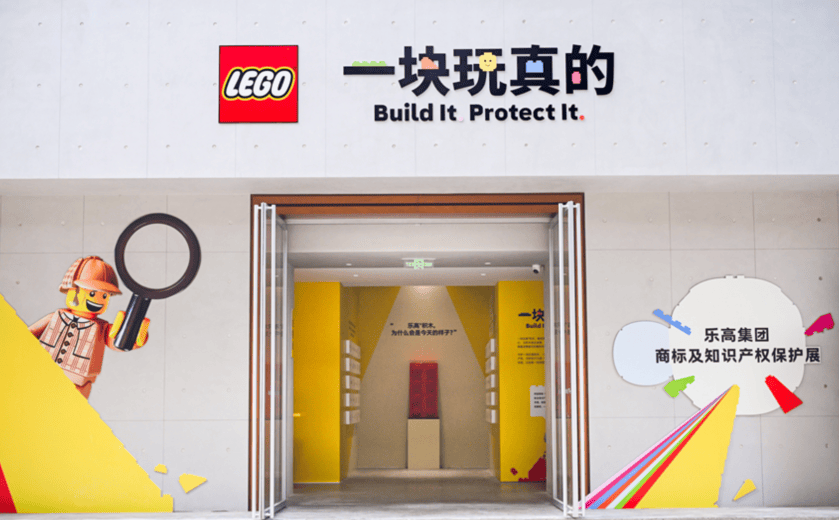
One of the most iconic and copied brands in the world, Lego, has generated surprising support for its trademarks and copyrights in China through an ambitious program of enforcement and education.
The Danish construction toy maker has gotten China to take its IP rights seriously in part, it says, by enforcement, education and taking the Chinese culture seriously, including having Lego designers visit and learn about the Chinese culture.
In late August, Lego Group launched a trademark and intellectual property protection exhibition, “Build It. Protect It.,” at Spurs Gallery in Beijing’s 798 Art District, with the goal of sharing what brand value means, especially in relation to trademarks and protecting creativity.
Lego has built consumer-familiar and trusted products and brand experiences via long-term dedicated investment. As a key part of the company’s 2026 trademark protection program, the exhibition in Beijing represents the brand’s first public education exhibition focusing on IP protection.
Significant Investment
Robin Smith, Vice President and General Counsel for China and Asia Pacific at the Lego Group spoke at the event, reports China.org, saying “Every Lego brick, every Lego product and every Lego experience represents years of creativity, design, testing and investment.”
The exhibition also features Lego’s notable legal battles. In the landmark “Lepin” case, nine individuals were sentenced up to six years in prison and fined 90 million yuan in 2020 (about $13.5 million USD). The reason was they sold over 300 million yuan of replica Lego products that infringed on Lego intellectual property.
Since 2015, the Lego Group has run public education initiatives to promote trademark and IP protection awareness. “Build it. Protect it.” is the first public exhibition. It appears not only to benefit Lego’s brand but also conveys basic IP precepts, which Chinese entrepreneurs, government and public appear to be getting more comfortable with.
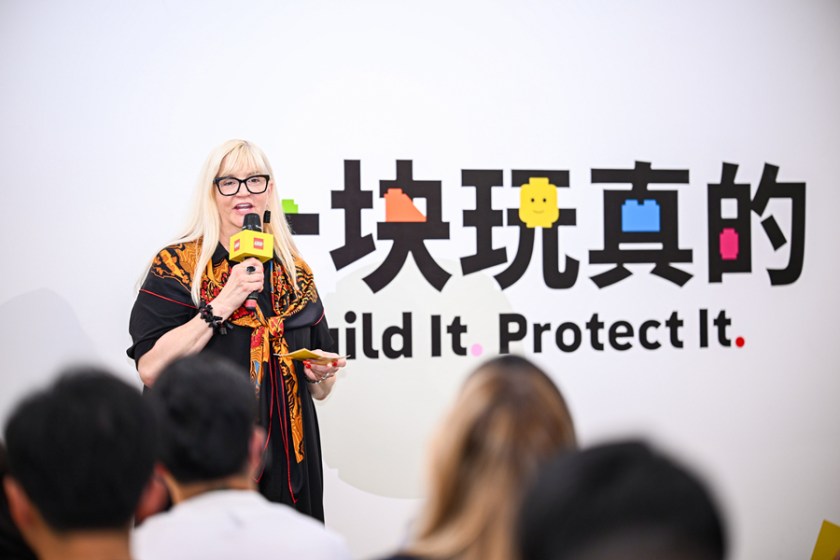
Robin Smith of Lego Group at the company’s IP exhibition in Beijing.
“We’ve already seen remarkable progress — not only in legislation, but also in the level of professionalization,” Smith told China Daily, the leading State run news organization. “Prosecutors, judges, police officers and administrative enforcement personnel are becoming increasingly specialized, and their understanding of the practical challenges we face continues to deepen.”
LEGO’s creative products are legally recognized as “artistic works” in China, writes CGTN, a part of China Media Group and the international division of China Central Television (CCTV).
“Every Lego brick, every Lego product and every Lego experience represents years of creativity, design, testing and investment.”
“They receive strong IP protection, which has become the cornerstone of confidence for the company to regard China as a priority market,” continues Smth. “Behind foreign companies’ willingness to innovate and deepen their presence lies a business environment that is fair, transparent and takes them seriously.”
Legal and Financial Victory
On April 22, 2024, reported the (U.S.) National Law Journal, the Shanghai No. 3 Intermediate People’s Court affirmed the Shanghai Huangpu District People’s Court earlier ruling against principal defendants Long XX Company, Chen XX and Chen YY in a case of criminal copyright infringement of Lego sets.
The Court sentenced Long XX Company to a fine of RMB 600 million RMB (about $90 million USD); sentenced the principal defendant Chen XX to nine years in prison and a fine of RMB 20 million RMB; sentenced the principal defendant Chen YY to eight years in prison and fined 15 million RMB. The remaining accomplices were sentenced to fixed-term imprisonment of one year, six months to four years, and corresponding fines.
Lego, an abbreviation of the Danish “leg godt,” meaning “play well,” plans to open flagship stores in Shanghai and Beijing. Let’s hope that China will continue to play well with Lego’s IP rights and that goodwill will spread to other foreign businesses.
Image source: china.org

